

100 קטעי קריאה באנגלית מדורגים עם שאלות: מתרגול בסיסי להבנת הנקרא אמיתית
התלמיד קורא את הקטע בפעם השלישית. הוא מכיר כמעט את כל המילים, מצליח לתרגם כל משפט בנפרד, ואפילו בטוח שהבין את הסיפור. ואז מגיעה השאלה הראשונה: Why did Tom change his plan? הוא חוזר מיד לשורה הראשונה, מחפש את המילה why בתוך הטקסט ולא מוצא אותה. כעבור דקה הוא אומר: “אני לא יודע”. לא מפני שהוא לא קרא, אלא מפני שאיש עדיין לא לימד אותו כיצד להפוך מילים ומשפטים למשמעות שלמה.
זהו אחד הפערים הנפוצים ביותר בלימוד אנגלית. תלמידים רבים מסוגלים לזהות מילים, לקרוא בקול ואפילו לתרגם, אבל מתקשים להבין מה הכותב ניסה לומר, לזהות קשר בין שני משפטים, להסיק מסקנה או לענות במילים שלהם. אצל ילדים הפער הזה מתבטא בציונים נמוכים בקטעי Unseen. אצל בני נוער הוא מופיע במבחנים ובבגרות. אצל מבוגרים הוא מתגלה כאשר הם קוראים הודעה מהעבודה, הוראות באתר, חוזה, מאמר מקצועי או דואר אלקטרוני ומרגישים שהם מבינים “בערך”, אך לא בטוחים מספיק כדי לפעול.
מאגר של קטעי קריאה באנגלית יכול לעזור מאוד, אך רק כאשר הוא בנוי נכון. קטע קל מדי אינו מפתח את הקורא. קטע קשה מדי גורם לו לעצור בכל שורה, לפתוח מילון ולהרגיש שאנגלית היא קיר גבוה שאי אפשר לעבור. תרגול יעיל נמצא באזור האמצע: הטקסט מובן ברובו, אך בכל פעם הוא דורש מהקורא צעד קטן נוסף—לזהות זמן, להבין כינוי גוף, לנחש מילה מההקשר, לחבר בין סיבה לתוצאה או להבחין בין עובדה לדעה.
לכן 100 קטעי הקריאה שלפניכם אינם מסודרים רק מן הקצר אל הארוך. הם מדורגים גם לפי מורכבות אוצר המילים, מבנה המשפטים, סוג המידע וסוגי השאלות. ברמה הראשונה מתרגלים איתור מידע מפורש והבנת פעולות יומיומיות. בהמשך עוברים לרצף אירועים, כוונת דמות, הסקת מסקנות, משמעות של מילים מתוך הקשר, זיהוי טענה מרכזית והבנת עמדה שאינה נאמרת באופן ישיר.
המטרה אינה “לסיים מאה קטעים” במהירות. המטרה היא לגלות מה קורה בזמן הקריאה. האם הקורא מאבד את המשמעות כאשר המשפט ארוך? האם הוא מתבלבל בין עבר להווה? האם הוא עונה בהעתקה אוטומטית? האם הוא מבין את הפרטים אך מחמיץ את הרעיון המרכזי? האם הוא יודע להסביר את התשובה באנגלית, או מבין רק כאשר הוא מתרגם הכול לעברית? כל תשובה מספקת מידע שמאפשר לבחור את התרגול הבא בצורה מדויקת יותר.
אפשר לעבוד עם המאגר באופן עצמאי, יחד עם הורה או במסגרת שיעורי אנגלית אונליין. כאשר מורה עובד עם תלמיד באופן אישי, הקטע הופך מכלי לבדיקת ידע לכלי לבניית ידע. המורה יכול לעצור ברגע הנכון, לבקש מהתלמיד לחשוב בקול, לזהות את מקור הטעות, להסביר מילה בהקשר, לשנות את השאלה או להפוך את הקטע לשיחה. כך הקריאה אינה נשארת פעילות שקטה ומנותקת, אלא נעשית בסיס לאוצר מילים, דקדוק, כתיבה ודיבור.
איך להשתמש ב־100 קטעי הקריאה בלי להפוך אותם לעוד חוברת שנשארת בצד
הטעות הראשונה בעבודה עם קטעי קריאה היא להתחיל מהקטע הראשון ולהתקדם לפי המספרים בלבד. המספור כאן נועד ליצור סדר, אך הוא אינו תחליף להתאמת רמה. ילד בכיתה ו׳ יכול להיות מצוין בקריאה בסיסית אך להתקשות בהסקת מסקנות. מבוגר עשוי להכיר אוצר מילים עסקי רחב, אך לקרוא לאט מפני שהוא מתרגם כל מילה. תלמיד אחר מסוגל להבין טקסט מורכב כשהוא קורא בשקט, אך מתקשה מאוד כאשר הוא נדרש להסביר אותו בקול.
מומלץ לבחור תחילה שלושה קטעים משלוש רמות סמוכות. אם הקטע הראשון מובן ללא מאמץ, השני דורש ריכוז והשלישי גורם לאובדן רצף, הרמה המתאימה נמצאת בדרך כלל סביב הקטע השני. אין צורך להגיע למאה אחוז הצלחה. תרגול מועיל כולל מעט אתגר, אך אינו אמור לגרום לכך שכל משפט שני יהפוך לחידת תרגום.
בקריאה הראשונה אין לפתוח מילון. קראו את הכותרת, עברו על הטקסט ונסו להבין מי משתתף, היכן הדברים קורים ומהו האירוע המרכזי. בקריאה השנייה סמנו מילים חשובות, חפשו קשרים כמו but, because, so, although וענו על השאלות. רק לאחר מכן בדקו מילים שלא הצלחתם להבין מן ההקשר. בדרך הזאת המילון משלים את החשיבה במקום להחליף אותה.
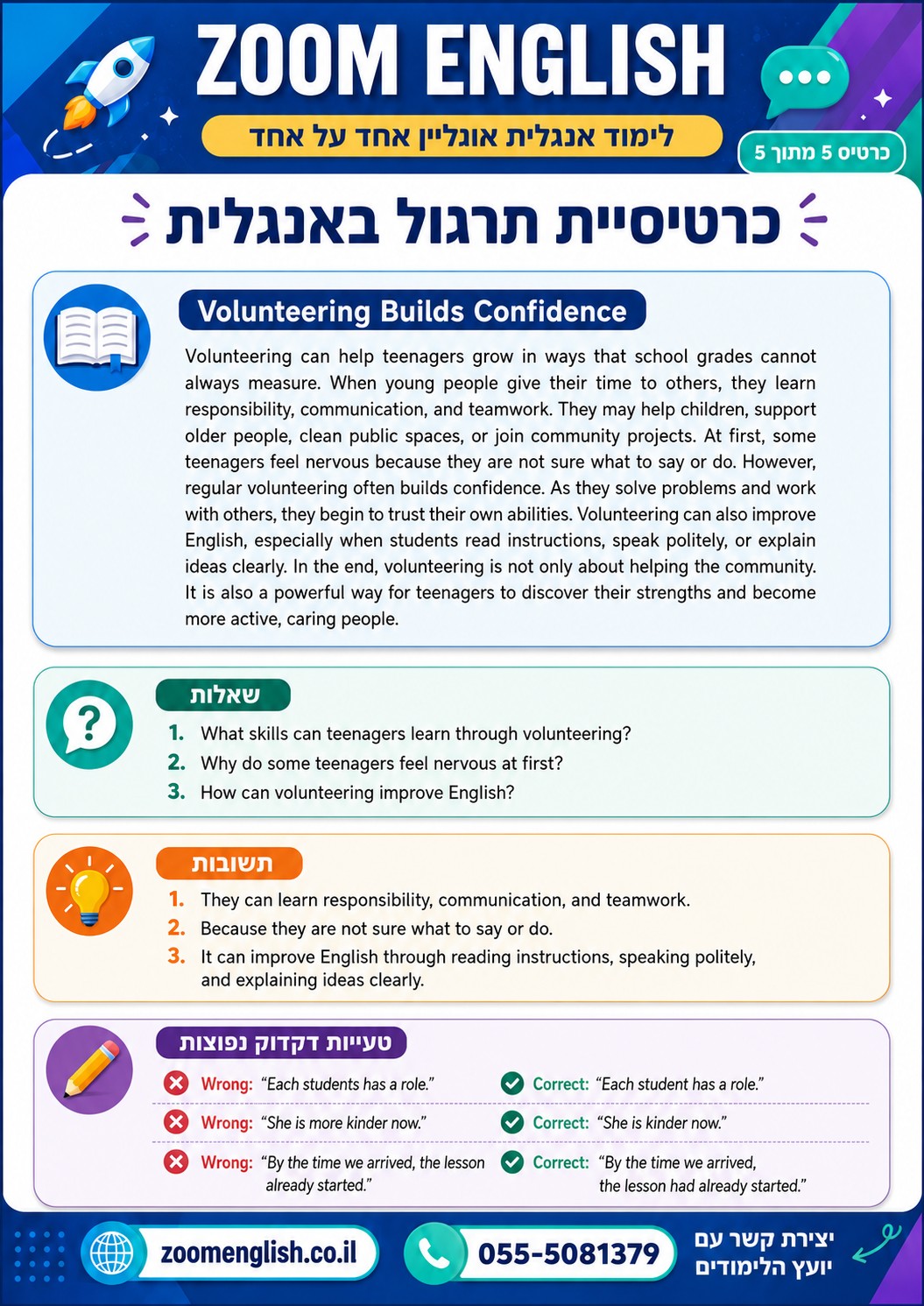
חשוב לענות במשפטים מלאים כאשר הרמה מאפשרת זאת. במקום לכתוב רק At seven, כתבו Maya leaves home at seven. התשובה המלאה מחייבת להשתמש בנושא, בפועל ובסדר מילים נכון. היא מחברת בין הבנת הנקרא לבין בניית משפטים ומאפשרת למורה לזהות אם הקושי נמצא בהבנה או בהפקת השפה.
אין צורך לבצע בכל קטע את כל הפעילויות האפשריות. ביום אחד אפשר להתמקד בהבנה כללית, ביום אחר באוצר מילים ובפעם השלישית בקריאה בקול. תלמיד שמנסה לבצע תרגום, שאלות, דקדוק, כתיבה, הקראה ושינון באותו מפגש עלול להתעייף לפני שהלמידה נקלטת. עדיף תרגול ממוקד של עשרים דקות מאשר שעה של עבודה מפוזרת.
בשיעור אנגלית אחד על אחד אפשר להשתמש באותו טקסט בדרכים שונות לחלוטין. תלמיד מתחיל יקרא משפט אחר משפט ויזהה מידע בסיסי. תלמיד מתקדם יותר יסכם, יביע דעה, יציע סוף חלופי או יספר על חוויה דומה. ההתאמה הזאת חשובה משום שהטקסט עצמו אינו קובע לבדו את רמת המשימה; גם השאלה שנשאלת והעזרה שניתנת משנות את דרגת הקושי.
טיפ מעשי: פתחו מחברת קריאה וחלקו כל עמוד לארבעה אזורים: מילים חדשות, משפט שימושי, טעות שגיליתי ושאלה שהייתי רוצה לשאול על הקטע. לאחר עשרה קטעים חזרו לעמודים הקודמים. כך תוכלו לראות אילו מילים חזרו, אילו טעויות נעלמו ואילו קשיים עדיין דורשים עבודה.
למה קריאה מדורגת מצליחה במקום שבו טקסטים אקראיים מתסכלים
קוראים רבים בוחרים טקסט לפי הנושא בלבד. הם אוהבים כדורגל ולכן פותחים כתבה מקצועית על העברות שחקנים; הם מתעניינים בטכנולוגיה ולכן מנסים לקרוא סקירה מלאה של מערכת חדשה. העניין אמנם מגביר מוטיבציה, אך רמת השפה יכולה להיות רחוקה מאוד מרמת הקורא. כאשר בכל משפט יש כמה מילים לא מוכרות ומבנים מורכבים, הזיכרון מתמלא בפרטים קטנים והמשמעות הכללית נעלמת.
קריאה מדורגת יוצרת מסלול שבו הקושי עולה באופן נשלט. לפי סולם CEFR, התקדמות בשפה נבחנת באמצעות היכולת לבצע פעולות תקשורתיות ברמות שונות, ולא רק באמצעות ידיעת רשימות מילים. קורא מתחיל מזהה מידע פשוט בנושאים מוכרים; בהמשך הוא מבין טקסטים יומיומיים, רעיונות מרכזיים, טיעונים, עמדות ומשמעויות מרומזות.
הבעיה בטקסט אקראי היא שאין בו בהכרח שליטה על צפיפות אוצר המילים או על התחביר. משפט אחד עשוי להיות פשוט, והמשפט הבא לכלול ביטוי, מטפורה, משפט תנאי ושלושה כינויי גוף שמתייחסים לאנשים שונים. הקורא מפרש את הקושי כהוכחה לכך שהאנגלית שלו “לא טובה”, אף שלמעשה נבחר עבורו חומר שאינו מתאים לשלב הנוכחי.
גם שאלות יכולות להיות מדורגות. השאלה Where does Ben work? דורשת איתור פרט. השאלה Why was Ben probably disappointed? דורשת חיבור בין פרטים. השאלה Do you agree with Ben’s decision? דורשת הבנה, עמדה והפקת שפה. תלמיד יכול לקרוא אותו טקסט ולהצליח בסוג אחד של שאלה אך להיתקע בסוג אחר.
כאשר מתעלמים מן ההתאמה, נוצרים שני נזקים. הראשון הוא לימודי: הקורא אינו מקבל מספיק הזדמנויות לקרוא ברצף ולתרגל מילים מוכרות בתוך הקשרים חדשים. השני הוא רגשי: כל טקסט הופך למבחן שמאיים לחשוף את מה שהוא אינו יודע. לאחר כמה חוויות כאלה התלמיד מתחיל לדחות את התרגול, לענות מהר מדי או לומר מראש שהוא “גרוע באנגלית”.
מורה פרטי לאנגלית אונליין יכול לזהות את נקודת הקושי בזמן אמת. הוא שומע היכן הקריאה נעצרת, רואה אילו מילים התלמיד מסמן, בודק כיצד נבחרה התשובה ומשנה מיד את רמת התמיכה. לפעמים התלמיד אינו זקוק לקטע קל יותר, אלא לשאלה ברורה יותר. לפעמים הוא מבין הכול אך חסר לו המבנה הלשוני הדרוש כדי לענות.
טיפ מעשי: לאחר כל קטע דרגו שלושה דברים מ־1 עד 5: קלות הקריאה, מידת ההבנה והיכולת להסביר את הטקסט. פער גדול בין הקריאה להבנה מגלה שהמילים נקראות ללא עיבוד מספיק. פער בין ההבנה להסבר מצביע לעיתים על צורך בתרגול דיבור ובניית משפטים, ולא על בעיית קריאה בלבד.
רמה 1: קטעים 1–25 — אנגלית בסיסית והבנת מידע מפורש
הקטעים הראשונים מתאימים ללומדים בתחילת הדרך, לילדים שכבר מכירים מילים בסיסיות ולמבוגרים שחוזרים ללמוד אחרי הפסקה ארוכה. המשפטים קצרים יחסית, הנושאים מוכרים והמידע הדרוש לתשובות מופיע באופן ברור בתוך הטקסט.
המטרה ברמה הזאת אינה לתרגם כל מילה לעברית, אלא לבנות הרגלי קריאה נכונים: לזהות מי מבצע את הפעולה, למצוא מילות זמן, להבין היכן האירוע מתרחש ולעקוב אחר רצף פשוט. כדאי לשים לב במיוחד לפעלים בזמן הווה פשוט, לכינויי גוף ולמילות יחס בסיסיות.
תלמידים מתחילים נוטים לקרוא מילה אחר מילה ולאבד את הקשר בין תחילת המשפט לסופו. לכן מומלץ לסמן יחידות משמעות, למשל after school, with her brother או every Friday, ולקרוא כל יחידה ברצף.
אם התלמיד טועה, אין למהר למסור את התשובה. בקשו ממנו להראות את המשפט שעליו הסתמך ולקרוא אותו שוב. לעיתים קרובות הוא יזהה בעצמו שהחליף בין שם של אדם למקום, התעלם ממילת שלילה או בחר בפרט שנראה מוכר אך אינו עונה על השאלה.
בשיעור אישי אפשר להרחיב כל קטע לשיחה קצרה. אחרי קטע על ארוחת בוקר, למשל, התלמיד יכול לספר מה הוא אוכל. אחרי טקסט על חיית מחמד אפשר לתרגל תיאור של בעל חיים. כך המילים אינן נשארות סגורות בתוך החוברת.
אין צורך לסיים את כל 25 הקטעים ברצף. אפשר לבחור חמישה נושאים שמעניינים את התלמיד, לחזור אליהם לאחר שבוע ולבדוק אם הקריאה נעשתה זורמת יותר. חזרה על טקסט מוכר אינה רמאות; היא דרך טובה לבנות דיוק ושטף.
קטע 1: Maya’s Morning
Maya gets up at seven o’clock. She washes her face and puts on her school clothes. Her father makes eggs and toast for breakfast. At eight o’clock, Maya takes her blue bag and walks to school with her friend Noa.
- What time does Maya get up?
- Who makes breakfast?
- How does Maya go to school?
תשובות: Maya gets up at seven o’clock. Her father makes breakfast. She walks to school with Noa.
קטע 2: The Red Bicycle
Dan has a new red bicycle. He rides it in the park every afternoon. He always wears a black helmet. On rainy days, the bicycle stays in the garage, and Dan plays games at home.
- What colour is Dan’s bicycle?
- Where does he ride it?
- What does he do on rainy days?
תשובות: It is red. He rides it in the park. He plays games at home.
קטע 3: A Small Cat
Lily is a small white cat. She sleeps on a chair near the kitchen window. In the morning, she eats cat food and drinks water. At night, she likes to sit next to Amir on the sofa.
- Where does Lily sleep?
- What does she drink?
- Who sits with Lily at night?
תשובות: Lily sleeps on a chair near the kitchen window. She drinks water. Amir sits with her.
קטע 4: The School Library
Our school library opens at nine. There are books, magazines and two computers inside. Ella visits the library on Tuesday. She reads a book about space and takes it home for one week.
- When does the library open?
- What is Ella’s book about?
- How long can she keep it?
תשובות: It opens at nine. The book is about space. She can keep it for one week.
קטע 5: Lunch at Work
Mr Green works in a large office. At one o’clock, he eats lunch with two colleagues. He usually brings rice and vegetables from home. Today, he has a cheese sandwich because he was busy in the morning.
- Where does Mr Green work?
- Who eats with him?
- Why does he have a sandwich today?
תשובות: He works in a large office. He eats with two colleagues. He has a sandwich because he was busy.
קטע 6: Sara’s Garden
Sara has a little garden behind her house. She grows tomatoes, onions and yellow flowers. She gives the plants water every evening. Her son helps her at the weekend.
- Where is Sara’s garden?
- Name one vegetable in the garden.
- When does her son help?
תשובות: It is behind her house. Tomatoes or onions grow there. Her son helps at the weekend.
קטע 7: The Bus Stop
Adam waits for bus number twelve outside the supermarket. The bus is five minutes late. Adam looks at his watch and sends a message to his teacher. He arrives at class before the lesson starts.
- Which bus does Adam wait for?
- Why does he send a message?
- Does he miss the lesson?
תשובות: He waits for bus number twelve. He sends a message because the bus is late. No, he arrives before the lesson starts.
קטע 8: Friday Dinner
On Friday evening, the Cohen family eats dinner together. Grandma brings soup, and Mr Cohen cooks chicken. The children put plates and glasses on the table. After dinner, everyone talks and eats fruit.
- Who brings soup?
- What do the children put on the table?
- What does the family eat after dinner?
תשובות: Grandma brings soup. The children put plates and glasses on the table. The family eats fruit.
קטע 9: A New Student
Leo is new at Hill School. He comes from Spain and speaks Spanish and English. His new classmate, Sam, shows him the classroom and the sports hall. At break time, they play basketball together.
- Where does Leo come from?
- Who helps him at school?
- What do the boys do at break time?
תשובות: Leo comes from Spain. Sam helps him. They play basketball.
קטע 10: The Birthday Cake
It is Nina’s tenth birthday. Her mother makes a chocolate cake with strawberries. Nina invites six friends to her house. They sing, play music and give Nina small presents.
- How old is Nina?
- What is on the cake?
- How many friends does she invite?
תשובות: Nina is ten. There are strawberries on the cake. She invites six friends.
קטע 11: At the Beach
Omer and his sister go to the beach early in the morning. The water is warm, but the wind is strong. They swim for twenty minutes and then build a sandcastle. Before they leave, they collect all their rubbish.
- When do they go to the beach?
- What is the weather like?
- What do they do before leaving?
תשובות: They go early in the morning. The water is warm and the wind is strong. They collect their rubbish.
קטע 12: The Music Lesson
Rina has a piano lesson every Wednesday. Her teacher sits beside her and listens carefully. Rina practises a new song three times. At first it is difficult, but the last time sounds much better.
- Which instrument does Rina play?
- How many times does she practise the song?
- Does she improve?
תשובות: She plays the piano. She practises three times. Yes, the last time sounds better.
קטע 13: A Cold Day
It is very cold today. Ben wears a thick coat, a green scarf and gloves. He walks quickly to the bakery and buys fresh bread. When he gets home, he makes hot tea.
- What does Ben wear around his neck?
- Where does he go?
- What does he make at home?
תשובות: He wears a green scarf. He goes to the bakery. He makes hot tea.
קטע 14: The Lost Pencil
Yuval cannot find his favourite pencil. He looks under his desk and inside his school bag. His friend points to the floor near the door. The pencil is there, next to a book.
- What is Yuval looking for?
- Who sees it?
- Where is the pencil?
תשובות: He is looking for his favourite pencil. His friend sees it. It is on the floor near the door.
קטע 15: Sunday Shopping
Mrs Lee goes shopping on Sunday morning. She needs milk, apples, potatoes and soap. The supermarket is crowded, so she waits in a long line. She returns home at eleven.
- When does Mrs Lee shop?
- Why does she wait?
- What time does she return?
תשובות: She shops on Sunday morning. She waits because the supermarket is crowded. She returns at eleven.
קטע 16: The Football Game
Tom’s team plays football after school. Tom is the goalkeeper. In the first half, he stops two difficult shots. His team scores one goal and wins the game.
- What is Tom’s position?
- How many shots does he stop?
- Who wins?
תשובות: Tom is the goalkeeper. He stops two shots. Tom’s team wins.
קטע 17: My Grandfather’s Shop
My grandfather owns a small shoe shop. It is on King Street, between a café and a bank. He opens the shop at ten and closes it at six. I help him during school holidays.
- What does the grandfather sell?
- Where is the shop?
- When does the writer help?
תשובות: He sells shoes. The shop is between a café and a bank. The writer helps during school holidays.
קטע 18: A Healthy Snack
At four o’clock, Mia feels hungry. She does not eat sweets because dinner is soon. She cuts a banana and an apple, puts them in a bowl and adds a little yoghurt.
- When does Mia feel hungry?
- Why does she avoid sweets?
- What does she add to the fruit?
תשובות: She feels hungry at four. Dinner is soon. She adds yoghurt.
קטע 19: The Class Pet
Class 4B has a small brown rabbit. Its name is Coco. Every day, two students give Coco food and clean its cage. During the weekend, the teacher takes Coco home.
- What animal is Coco?
- Who cares for Coco each day?
- Where does Coco go at the weekend?
תשובות: Coco is a rabbit. Two students care for it. It goes to the teacher’s home.
קטע 20: The Evening Walk
After dinner, David walks around his neighbourhood. He listens to quiet music and watches the lights in the houses. The walk takes half an hour. It helps him relax before bed.
- When does David walk?
- How long is the walk?
- Why does he walk?
תשובות: He walks after dinner. It takes half an hour. It helps him relax.
קטע 21: A Rainy Picnic
The family plans a picnic in the park, but heavy rain begins. They put a blanket on the living-room floor and eat sandwiches there. The children laugh and say it is an indoor picnic.
- Why do they stay inside?
- Where do they put the blanket?
- How do the children feel?
תשובות: They stay inside because of the rain. They put the blanket on the living-room floor. They feel happy and laugh.
קטע 22: The Early Train
Kim needs to catch the six-thirty train. She prepares her bag the night before and sets two alarms. In the morning, she leaves home early and reaches the station ten minutes before the train.
- What time is Kim’s train?
- When does she prepare her bag?
- Is she late?
תשובות: The train is at six-thirty. She prepares her bag the night before. No, she arrives ten minutes early.
קטע 23: The Art Project
Daniel makes a poster for his science class. He draws a large tree and writes the names of its parts. His sister helps him colour the leaves. The teacher puts the finished poster on the classroom wall.
- Which class is the poster for?
- Who colours the leaves?
- Where does the teacher put the poster?
תשובות: It is for science class. Daniel’s sister helps colour the leaves. The poster goes on the classroom wall.
קטע 24: The Wrong Door
Hana arrives at the community centre for a dance class. She opens Room 3 and sees people painting pictures. A woman tells her that the dance class is in Room 5. Hana thanks her and walks upstairs.
- Why does Hana visit the centre?
- What are people doing in Room 3?
- Where is the correct room?
תשובות: She visits for a dance class. People are painting. Room 5 is upstairs.
קטע 25: The Thank-You Note
Jack’s neighbour gives him a book for his birthday. Jack enjoys the story and reads it in two days. He writes a short thank-you note and puts it through his neighbour’s door.
- What present does Jack receive?
- How long does he take to read it?
- Why does he write a note?
תשובות: He receives a book. He reads it in two days. He writes to thank his neighbour.
רמה 2: קטעים 26–50 — רצף אירועים, סיבות והבנת הקשר
ברמה השנייה המשפטים נעשים מעט ארוכים יותר, ולעיתים התשובה אינה נמצאת באותו ניסוח שמופיע בשאלה. הקורא צריך להבין שמילים שונות יכולות לתאר את אותו רעיון. למשל, אם בטקסט נאמר שמישהו decided to stay home because he felt unwell, התשובה לשאלה מדוע לא יצא אינה חייבת לכלול את המילים המדויקות של השאלה.
כאן מתחילה להופיע חשיבותן של מילות הקישור. Because מציגה סיבה, so מציגה תוצאה, but מסמנת ניגוד ו־before או after עוזרות לבנות סדר זמנים. תלמיד שמתעלם מהמילים הקטנות האלה עשוי להבין את כל שמות העצם ועדיין לפרש את האירוע בצורה הפוכה.
ברמה הזאת כדאי להתחיל לבקש מן התלמיד לסכם את הקטע במשפט אחד. סיכום אינו חזרה על כל הפרטים, אלא בחירה של הדבר החשוב ביותר. אם התלמיד מספר רק מה היה צבע התיק או באיזו שעה יצאה הרכבת, ייתכן שהוא אוסף פרטים אך עדיין אינו מזהה את מרכז הטקסט.
אפשר גם לתרגל ניחוש מילים מתוך ההקשר. אין לצפות שהתלמיד יידע כל מילה. במקום לתרגם מיד, בדקו אם המילה מתארת אדם, פעולה, מקום או תחושה. חפשו דוגמה, ניגוד או תוצאה שמופיעים לידה. גם ניחוש חלקי הוא מיומנות חשובה, משום שבקריאה אמיתית לא תמיד יש זמן לעצור ולבדוק מילון.
מורה לאנגלית בזום יכול להציג את הקטע על המסך, לסמן קשרים בצבעים ולבקש מהתלמיד להסביר כיצד הגיע לתשובה. התהליך חשוב יותר מהניקוד. כאשר תלמיד בוחר תשובה נכונה מסיבה לא נכונה, הוא עלול לחזור על אותה טעות בקטע הבא. כאשר הוא טועה אך מציג חשיבה הגיונית, אפשר לכוון אותו בעזרת רמז קטן.
טיפ מעשי: לאחר כל קטע כתבו שלושה משפטים: “בהתחלה…”, “לאחר מכן…” ו“בסוף…”. הפעילות הפשוטה הזאת מחזקת רצף, שימוש בזמנים ויכולת לספר מחדש—שלוש מיומנויות שמשפיעות גם על כתיבה וגם על דיבור.
קטע 26: The Forgotten Lunch
When Ella reached school, she discovered that her lunchbox was still on the kitchen table. She did not have enough money to buy lunch, so she planned to eat only an apple. At lunchtime, her friend Leah shared a sandwich with her. Ella thanked Leah and promised to bring an extra snack the next day.
- Where was Ella’s lunchbox?
- Why could she not buy lunch?
- How was the problem solved?
- What did Ella promise?
תשובות: It was on the kitchen table. Ella did not have enough money. Leah shared a sandwich. Ella promised to bring an extra snack.
קטע 27: A Different Route
Ben usually drives to work along River Road, but road workers closed it on Monday. He followed a sign through a quiet village and arrived fifteen minutes later than usual. Although the trip was longer, he enjoyed seeing the old houses and decided to use the route again on a free afternoon.
- Why did Ben change his route?
- How much later did he arrive?
- What did he enjoy?
- Will he use the route again?
תשובות: River Road was closed. He arrived fifteen minutes late. He enjoyed the old houses. Yes, he may use it on a free afternoon.
קטע 28: The School Sale
Students at Park School wanted to buy new sports equipment. They collected books and toys that their families no longer needed and organised a sale. The weather was sunny, and many neighbours came. By the end of the day, the students had enough money for footballs, basketballs and a new net.
- Why did the students organise a sale?
- What did they sell?
- Who came to the sale?
- Was the event successful?
תשובות: They wanted sports equipment. They sold used books and toys. Neighbours came. Yes, they raised enough money.
קטע 29: The Quiet Café
Ruth needed a place to prepare for an exam. The library was full, and her neighbours were repairing their kitchen. She found a small café at the end of her street. The owner showed her a quiet table near a window, and Ruth studied there for two hours without interruption.
- Why could Ruth not study at home?
- Why did she avoid the library?
- Where did she sit?
- What does “without interruption” suggest?
תשובות: Her neighbours were making noise. The library was full. She sat near a window. Nobody disturbed her.
קטע 30: Learning to Cook
For years, Amir ordered food whenever he was hungry. When he moved into his own flat, he decided to learn three simple meals. His first soup was too salty, and his first cake was very dry. Instead of giving up, he watched short cooking lessons and practised every weekend. A month later, he invited friends to dinner.
- What did Amir do before learning to cook?
- What went wrong with his first soup?
- How did he improve?
- What shows that he became more confident?
תשובות: He ordered food. The soup was too salty. He watched lessons and practised. He invited friends to dinner.
קטע 31: The Broken Phone
Nora dropped her phone while getting off the bus. The screen cracked, but the phone still worked. A repair shop offered to fix it that afternoon, yet the price was higher than Nora expected. She decided to use the phone carefully for another week while comparing prices at other shops.
- How did the phone break?
- Could Nora still use it?
- Why did she wait before repairing it?
- What will she do during the week?
תשובות: She dropped it. Yes, it still worked. The repair was expensive. She will compare prices.
קטע 32: The Community Garden
An empty piece of land near the station was full of rubbish. Local residents asked the council for permission to turn it into a garden. Families planted vegetables, teenagers painted the fence and older neighbours taught children how to care for the soil. Within a few months, the area became a popular meeting place.
- What was the land like at first?
- Whose permission did residents need?
- How did teenagers help?
- What changed after a few months?
תשובות: It was empty and dirty. They needed the council’s permission. Teenagers painted the fence. The area became a garden and meeting place.
קטע 33: The Wrong Size
Paul ordered a winter jacket online. He chose the same size as his old jacket, but the new one was much smaller. The website allowed free returns, so Paul printed a label and sent it back. Before ordering another jacket, he read the size guide and measured himself carefully.
- Why did Paul choose that size?
- What was wrong with the jacket?
- Did returning it cost money?
- What did Paul do differently next time?
תשובות: It matched his old jacket’s size. It was too small. No, the return was free. He checked the guide and measured himself.
קטע 34: An Unexpected Guest
During breakfast, the Levin family heard a soft sound near the back door. A wet dog was standing outside. It had a collar but no address. They dried the dog, gave it water and posted a photograph in a neighbourhood group. Two hours later, its worried owner arrived to take it home.
- Where did the family find the dog?
- Why could they not contact the owner directly?
- How did they look for the owner?
- How did the owner probably feel?
תשובות: It was by the back door. There was no address on its collar. They posted a photograph. The owner was probably worried and then relieved.
קטע 35: The First Presentation
Jade had never spoken in front of her whole class. Before her presentation, her hands felt cold and she spoke too quickly. Her teacher asked her to pause and look at one friendly face. Jade took a breath, continued more slowly and finished every part of her talk. She was still nervous, but she was proud that she did not stop.
- How did Jade feel at first?
- What advice did the teacher give?
- Did Jade become completely calm?
- Why was she proud?
תשובות: She felt nervous. The teacher told her to pause and look at a friendly face. No, she remained nervous. She completed the presentation.
קטע 36: A Weekend Without Screens
The Harris family noticed that everyone was spending too much time on phones and tablets. They agreed to keep their devices in a drawer from Saturday morning until Sunday evening. At first, the children complained. Later, the family played cards, baked bread and visited a nearby forest. On Sunday night, nobody hurried to take a device back.
- Why did the family put away their devices?
- How did the children react at first?
- Name two activities they did.
- What does the final sentence suggest?
תשובות: They wanted less screen time. The children complained. They played cards, baked or visited a forest. They enjoyed the weekend more than expected.
קטע 37: The Late Invitation
On Thursday, Max received an invitation to a concert on Friday night. He wanted to go, but he had promised to help his cousin move house. Max called his cousin and explained the situation. His cousin had already found several helpers, so he told Max to enjoy the concert and come on Saturday instead.
- What did Max receive?
- Why was he unsure about going?
- How did he solve the problem?
- When will he help his cousin?
תשובות: He received a concert invitation. He had promised to help his cousin. He called and explained. He will help on Saturday.
קטע 38: A Better Study Plan
Leah used to study for tests late at night. She often became tired and forgot what she had read. Before her history exam, she tried a different plan. She studied for twenty-five minutes, took a five-minute break and reviewed the main points the next morning. Her mark improved, but more importantly, she felt calmer during the exam.
- What was wrong with Leah’s old method?
- How long were her study periods?
- When did she review?
- What improvement mattered besides her mark?
תשובות: She became tired and forgot information. She studied for twenty-five minutes. She reviewed the next morning. She felt calmer.
קטע 39: The Local Museum
A small museum in Eli’s town was in danger of closing because few people visited it. Eli’s class created short videos about its most interesting objects and shared them online. The videos attracted families and tourists. The museum later asked the students to prepare an audio guide for young visitors.
- Why might the museum have closed?
- What did the students create?
- What happened after the videos appeared online?
- What new task did the museum offer?
תשובות: It had too few visitors. They made videos. More people visited. The students were asked to create an audio guide.
קטע 40: The Noisy Neighbour
Every evening, loud music came from the flat above Maria’s. She first tried to ignore it, but she could not sleep well. Instead of making an angry complaint, she spoke politely to her neighbour. He was surprised because he did not realise the sound travelled through the floor. After that, he used headphones at night.
- How did the music affect Maria?
- What did she avoid doing?
- Why was the neighbour surprised?
- How did he change his behaviour?
תשובות: She could not sleep well. She avoided an angry complaint. He did not know the music was so loud downstairs. He used headphones.
קטע 41: The Missing Key
After a long day, Simon reached his front door and could not find his key. He checked every pocket twice. Then he remembered placing it beside the computer at work. His flatmate was an hour away, so Simon went to a café, called the office manager and arranged to collect the key the next morning.
- Where was Simon’s key?
- Why could his flatmate not help quickly?
- Where did Simon wait?
- When would he collect the key?
תשובות: It was at work. His flatmate was an hour away. Simon waited in a café. He would collect it the next morning.
קטע 42: The Charity Run
Natalie signed up for a five-kilometre charity run, although she had never run that far. She began by walking and running for short periods three times a week. After six weeks, she completed the full distance in training. On race day, she ran slowly, finished smiling and raised money for a children’s hospital.
- Why was the run a challenge?
- How often did Natalie train?
- What happened after six weeks?
- What were her two achievements on race day?
תשובות: She had never run five kilometres. She trained three times weekly. She completed the distance. She finished the race and raised money.
קטע 43: The Book Club Choice
Members of a book club could not agree on their next book. Some wanted a mystery, while others preferred a true story. One member suggested choosing a historical mystery based on real events. The idea included something for both groups, and everyone agreed to try it.
- What two types of books did members want?
- What compromise was suggested?
- Why did the suggestion work?
- What does “compromise” mean in this context?
תשובות: They wanted a mystery or a true story. They chose a historical mystery based on real events. It satisfied both groups. A compromise is a solution in which each side gets part of what it wants.
קטע 44: Working from Home
When Tariq began working from home, he answered emails from the sofa and often worked until late. He soon felt that work was taking over his whole day. He moved a small desk into the spare room and decided to finish at five-thirty. Closing the door at the end of the day helped him separate work from home life.
- What problem did Tariq experience?
- What two changes did he make?
- Why did he close the door?
- What is the main lesson of the text?
תשובות: Work filled too much of his day. He created a workspace and set a finishing time. The closed door marked the end of work. Clear boundaries can improve home working.
קטע 45: The Empty Battery
During a day trip, Eva used her phone to take photographs and follow a map. By afternoon, the battery was almost empty. She still needed the phone to show her train ticket, so she turned off unnecessary apps and stopped taking pictures. At the station, the phone had just enough power to display the ticket.
- What used most of Eva’s battery?
- Why did she need to save power?
- How did she save it?
- Was her decision successful?
תשובות: Photos and the map used the battery. Her train ticket was on the phone. She closed apps and stopped taking photos. Yes, she displayed the ticket.
קטע 46: A New Hobby
After moving to a new city, Grace wanted to meet people but felt uncomfortable at large social events. She joined a small photography walk instead. The group explored one neighbourhood each Sunday and compared pictures afterwards. Talking about photographs gave Grace an easy way to begin conversations, and she soon made two friends.
- Why did Grace avoid large events?
- What group did she join?
- Why was conversation easier there?
- What was the result?
תשובות: Large events made her uncomfortable. She joined a photography walk. The photos provided a natural topic. She made two friends.
קטע 47: Saving Water
Students measured how much water ran from a tap while they brushed their teeth. They were surprised by the amount. The class designed signs asking everyone to turn taps off and reported a leaking pipe near the sports hall. A month later, the school’s water use was lower.
- What surprised the students?
- What message appeared on their signs?
- What other problem did they report?
- How do we know the project helped?
תשובות: The amount of wasted water surprised them. The signs asked people to turn taps off. They reported a leaking pipe. Water use fell.
קטע 48: The Job Interview
Before her first job interview, Yasmin prepared answers to common questions. However, she did not memorise every sentence. Instead, she wrote a few key points and practised explaining them in different words. During the interview, one question was unexpected, but she stayed calm and used a real example from a school project.
- How did Yasmin prepare?
- Why did she avoid memorising full answers?
- What happened in the interview?
- How did she handle the unexpected question?
תשובות: She prepared key points and practised. Flexible preparation helped her speak naturally. She received an unexpected question. She used a real example.
קטע 49: The Delayed Flight
A storm delayed Daniel’s evening flight. The airline offered passengers food vouchers and announced that the new departure time would be midnight. Daniel was disappointed, but he found a quiet seat, charged his laptop and completed some work. When boarding finally began, he had less work waiting for him the next day.
- What caused the delay?
- What did passengers receive?
- How did Daniel use the waiting time?
- What positive result came from the delay?
תשובות: A storm caused it. Passengers received food vouchers. Daniel worked on his laptop. He reduced the next day’s workload.
קטע 50: The Honest Customer
After leaving a shop, Priya noticed that the cashier had returned too much change. She was already halfway home and it was raining heavily. For a moment, she considered returning the money another day. Then she turned around and went back. The cashier thanked her and said the missing money would otherwise have come from his wages.
- What mistake did the cashier make?
- Why was returning difficult?
- What decision did Priya make?
- Why was the cashier especially grateful?
תשובות: He gave too much change. Priya was far away and it was raining. She returned immediately. The loss might have been taken from his wages.
רמה 3: קטעים 51–75 — רעיון מרכזי, מסקנות ואוצר מילים מתוך הקשר
ברמה השלישית הקריאה כבר אינה עוסקת רק במה שקרה, אלא גם בשאלה מדוע זה חשוב. הטקסטים כוללים דעות, שינויים בגישה, בעיות שאין להן פתרון מושלם ומילים שאפשר להבין רק מתוך המשפטים שסביבן. הקורא נדרש להחזיק כמה פרטים בזיכרון ולראות כיצד הם מתחברים לטענה אחת.
תלמידים רבים מגיעים לשלב הזה עם הרגל של “ציד מילים”. הם מחפשים בשאלה מילה בולטת, מאתרים אותה בטקסט ומעתיקים את המשפט הקרוב. השיטה עשויה לעבוד בשאלות פשוטות, אך היא נכשלת כאשר הטקסט משתמש במילה נרדפת, כאשר התשובה מפוזרת על פני שתי פסקאות או כאשר השאלה מבקשת להסיק ולא לאתר.
כדי להתקדם, מומלץ לקרוא כל פסקה ולנסח בשוליים שתיים או שלוש מילים שמתארות את תפקידה: “הצגת הבעיה”, “דוגמה”, “תגובה”, “פתרון חלקי” או “עמדת הכותב”. הפעולה מכריחה את הקורא לראות מבנה ולא רק משפטים נפרדים.
ברמה הזאת אפשר להתחיל להבחין בין עובדה, דעה והנחה. משפט כמו “החנות נסגרה בשש” הוא עובדה בתוך הטקסט. “השירות היה מאכזב” הוא שיפוט. “ייתכן שהמנהל לא ציפה למספר גדול של לקוחות” הוא הסבר אפשרי. ההבחנה חשובה לקריאה של כתבות, ביקורות, הודעות מקצועיות ומאמרים.
במהלך שיעורי אנגלית אונליין אחד על אחד, המורה יכול לבקש מן התלמיד להגן על תשובתו באמצעות ראיה. במקום להסתפק ב“נראה לי”, התלמיד מצביע על שני פרטים ומסביר את הקשר ביניהם. זהו תרגול עמוק של שפה ושל חשיבה, והוא מועיל גם בכתיבה עיונית, בראיונות עבודה ובשיחות מקצועיות.
טיפ מעשי: כאשר אתם נתקלים במילה לא מוכרת, אל תשאלו תחילה “מה התרגום?”. שאלו: האם היא חיובית או שלילית? האם היא מתארת פעולה, אדם או מצב? איזו מילה יכולה להחליף אותה בלי לשנות את הרעיון? רק לאחר הניחוש בדקו במילון.
קטע 51: The Repair Café
Once a month, volunteers in Brookfield open a “repair café” in the town hall. Residents bring broken lamps, small appliances, clothes and bicycles. Instead of repairing each item silently, volunteers explain what they are doing and encourage owners to help. Not everything can be saved, but many objects return to use. The project reduces waste and also passes practical knowledge from one person to another.
- How is the repair café different from an ordinary repair shop?
- What are two aims of the project?
- What does “passes practical knowledge” mean?
- What is the main idea?
תשובות: Owners participate and learn. The project reduces waste and teaches repair skills. Knowledge is shared between people. The café gives objects and skills a longer life.
קטע 52: A Shorter Meeting
Employees at a design company complained that weekly meetings lasted too long and rarely ended with clear decisions. The manager replaced the one-hour meeting with a twenty-minute standing meeting. Every participant had to report one achievement, one problem and one next step. Some complex issues still required separate discussions, but the main meeting became more focused. After a trial month, the team voted to keep the new format.
- What was wrong with the original meetings?
- How did the format change?
- Why were separate discussions still needed?
- What can be inferred from the vote?
תשובות: Meetings were long and unclear. They became short, standing and structured. Complex issues needed more time. Most employees preferred the new method.
קטע 53: The Language Exchange
Clara wanted to improve her Italian, while Marco wanted more practice in English. They agreed to meet online twice a week and divide each conversation equally between the two languages. At first, both corrected every small error, and the conversation became slow and uncomfortable. They later decided to note only important mistakes and discuss them at the end. As a result, their conversations became more natural without losing their learning value.
- What problem appeared at first?
- What change did they make?
- Why did the new method work better?
- What general lesson can language learners take from the text?
תשובות: Constant correction interrupted the conversation. They delayed important corrections. This preserved fluency and still allowed feedback. Correction should support communication, not stop it.
קטע 54: An Unpopular Decision
A school removed vending machines that sold sugary drinks. Many students protested, saying they should be free to choose. The head teacher explained that water remained available and that the school had a responsibility to create a healthier environment. After several weeks, complaints decreased. However, a student group continued to argue that education would have been better than a complete ban.
- Why did students initially protest?
- How did the head teacher justify the decision?
- Did everyone eventually agree?
- What two approaches are compared?
תשובות: Students felt their choice was limited. The school wanted a healthier environment. No, one group still disagreed. The text compares banning products with educating students.
קטע 55: The Silent Customer
A restaurant owner assumed that customers would complain if something was wrong. Yet online reviews showed that many disappointed visitors had remained silent during their meals and simply decided not to return. The owner began asking one specific question before customers left: “Is there anything we could improve today?” Staff members also received permission to solve small problems immediately. Ratings slowly rose, but the owner valued the direct feedback even more.
- What assumption did the owner make?
- Why was that assumption mistaken?
- What two changes were introduced?
- Why might direct feedback be more valuable than a rating?
תשובות: He believed unhappy customers would speak up. Many left silently. Staff asked a specific question and could solve problems. Direct feedback explains what needs improvement.
קטע 56: The Borrowed Laptop
When Joel’s laptop stopped working before an important deadline, his colleague lent him a spare one. Joel copied the files he needed but also found several private folders on the desktop. Although he was curious, he did not open them. He completed his report, deleted his own files and returned the laptop. His colleague later thanked him for respecting both the equipment and the information stored on it.
- Why did Joel borrow the laptop?
- What ethical choice did he face?
- What did he do before returning it?
- Which quality does the story mainly demonstrate?
תשובות: His own laptop failed before a deadline. He could have opened private folders. He deleted his files. The story demonstrates respect and trustworthiness.
קטע 57: The Empty High Street
Several shops on Westford’s main street closed after customers began buying more products online. To attract visitors, the council organised weekend markets, outdoor performances and free parking for the first hour. These events increased foot traffic, but permanent shops still struggled during ordinary weekdays. Some owners now believe the street needs housing, workspaces and services rather than relying only on traditional retail.
- Why did shops close?
- What did the council try?
- What limitation did the events have?
- What broader solution do some owners suggest?
תשובות: Online shopping reduced customers. The council held events and offered parking. Weekdays remained quiet. Owners suggest creating a mixed-use area.
קטע 58: The Difficult Apology
During a group project, Elena blamed Noah for losing an important file. Later, she discovered that she had saved it in the wrong folder herself. Elena felt embarrassed and considered saying nothing because the file had been found. Instead, she apologised in front of the whole group, just as she had criticised Noah in front of them. Noah accepted the apology, and the group agreed on a clearer system for naming files.
- Why was Elena’s original accusation unfair?
- Why might she have remained silent?
- Why did she apologise publicly?
- What practical change followed?
תשובות: Elena had misplaced the file. She felt embarrassed and the problem was solved. The criticism had also been public. The group created a clearer naming system.
קטע 59: A Library of Things
A neighbourhood library began lending tools, camping equipment and kitchen machines as well as books. Supporters argued that people often buy expensive objects they use only once or twice. Borrowing saves money and reduces the number of unused products stored in homes. Critics worried about damage and maintenance costs. The library responded by offering short instruction sessions and charging a small membership fee.
- Why might people prefer borrowing these objects?
- What concern did critics raise?
- How did the library respond?
- What is meant by a “library of things”?
תשובות: Borrowing saves money and space. Critics worried about damage and maintenance. The library offered training and charged a fee. It is a service that lends useful objects.
קטע 60: The First Negative Review
After months of positive comments, a small hotel received a harsh online review. The manager’s first reaction was to defend every decision. Before replying, she asked two employees to read the review and identify any fair points. They discovered that unclear check-in instructions had caused most of the guest’s frustration. The manager apologised, explained the change being made and avoided arguing about minor details. Her calm reply impressed several future guests.
- What did the manager initially want to do?
- What caused the guest’s main problem?
- How did the final response differ from her first reaction?
- What unexpected benefit resulted?
תשובות: She wanted to defend the hotel. The instructions were unclear. She apologised and focused on improvement. Future guests appreciated her response.
קטע 61: The Flexible Deadline
A college lecturer noticed that some students were submitting rushed assignments after working long hours in paid jobs. Rather than removing deadlines, she introduced one automatic forty-eight-hour extension that each student could use once during the term without explanation. Most students saved it for a genuine difficulty, and late submissions decreased overall. The lecturer concluded that limited flexibility encouraged responsibility better than repeated individual negotiations.
- Why were some assignments rushed?
- What new policy was introduced?
- Did students misuse the policy?
- Why might the policy reduce late work?
תשובות: Students had demanding jobs. Each could use one extension. Most used it responsibly. Clear limited flexibility helped them plan.
קטע 62: A Question of Speed
Leo read English texts very slowly because he stopped whenever he met an unfamiliar word. His teacher asked him to read a short article for two minutes without a dictionary and mark, rather than investigate, difficult words. Leo was surprised that he could still understand the main argument. Later, they examined only the words that were essential. His reading did not become fast immediately, but it became less dependent on constant translation.
- What habit slowed Leo down?
- What new strategy did he try?
- What surprised him?
- What kind of progress did he make?
תשובות: He checked every unknown word. He marked words and continued reading. He understood the main argument. He became less dependent on translation.
קטע 63: The Shared Office
Two departments moved into one open office. One team liked discussing ideas aloud, while the other needed long periods of concentration. At first, each side considered the other inconsiderate. A meeting revealed that the conflict came from different working styles rather than bad intentions. They created quiet hours, bookable discussion areas and a simple signal showing when someone should not be interrupted.
- What caused the conflict?
- What misunderstanding existed?
- Name two solutions.
- What lesson does the situation illustrate?
תשובות: The teams had different needs. Each thought the other was inconsiderate. They created quiet hours and discussion spaces. Clear communication can solve conflicts caused by assumptions.
קטע 64: The Cheap Shoes
Mina bought the cheapest running shoes she could find. After two months, the soles wore out and she replaced them with another low-cost pair. Her friend pointed out that she had spent more on two weak pairs than he had spent on one durable pair. Mina realised that price and value were not the same. For her next purchase, she compared comfort, expected use and repair options as well as cost.
- Why were the first shoes poor value?
- What distinction did Mina learn?
- Which factors did she later compare?
- Is the passage arguing that expensive products are always better?
תשובות: They wore out quickly and had to be replaced. Low price does not always mean good value. She compared comfort, durability, repair and cost. No, it argues for considering total value.
קטע 65: The Unfinished Course
Victor enrolled in several online courses but rarely completed them. He watched many opening lessons, took detailed notes and then lost interest when exercises became difficult. Eventually, he chose one short course connected to a real task at work. He scheduled two study sessions each week and used each new skill immediately. Finishing that course taught him that practical purpose and regular application mattered more than collecting lessons.
- At what point did Victor usually stop?
- How was the final course different?
- What supported his progress?
- What is the main message?
תשובות: He stopped when exercises became difficult. The course related to a real need. A schedule and immediate use supported him. Focused application is more useful than passive course collection.
קטע 66: The Anonymous Suggestion Box
A company introduced an anonymous suggestion box because junior employees were reluctant to challenge senior managers. It quickly filled with complaints, but many were too general to act upon. The company changed the form, asking contributors to describe the problem, its effect and one possible improvement. The number of suggestions fell, yet their quality increased. Managers also began publishing responses so employees could see which ideas were considered.
- Why was anonymity introduced?
- What problem appeared?
- How was the form improved?
- Why did publishing responses matter?
תשובות: Junior staff feared speaking openly. Complaints lacked detail. The form requested evidence and a solution. Responses showed that ideas were being taken seriously.
קטע 67: The Community Translator
When new families arrived in the neighbourhood, Fatima often helped them understand school letters. She spoke both languages well, but soon realised that direct translation was not always enough. Some families needed explanations of unfamiliar school routines, while staff needed help understanding cultural expectations. Fatima’s role gradually became one of mediation: she did not merely replace words but helped both sides interpret meaning and avoid misunderstanding.
- Why was direct translation insufficient?
- What did families need besides translated words?
- How did Fatima’s role change?
- What does “mediation” mean in this passage?
תשובות: Context and customs were unfamiliar. Families needed explanations. She connected perspectives. Mediation means helping parties understand meaning and context.
קטע 68: The Failed Garden
Raj planted the same vegetables that grew successfully in his brother’s garden. However, Raj’s garden received less sunlight and had heavier soil. Most plants remained small. Instead of deciding that he was “bad at gardening”, Raj asked a local gardener to examine the conditions. The following year, he chose plants suited to shade and improved the soil. His experience showed that copying a successful method without considering context can lead to failure.
- Why did Raj expect his vegetables to grow?
- Which conditions were different?
- How did he respond to failure?
- What broader lesson does the story offer?
תשובות: The same plants worked for his brother. Raj had less sun and heavier soil. He sought advice and adapted. A method must fit the situation.
קטע 69: The Four-Day Trial
A small software company tested a four-day working week without reducing salaries. Employees had to shorten meetings, protect focused work time and reduce unnecessary reports. Productivity remained stable, and sick days fell. However, the customer support team struggled because clients still needed help on Fridays. The company kept the shorter week for most staff but created rotating Friday shifts for support workers.
- What had to change for the trial to work?
- What positive results appeared?
- Which team faced a difficulty?
- How was the policy adapted?
תשובות: Work processes became more efficient. Productivity stayed stable and sick days fell. Customer support struggled. Friday shifts rotated.
קטע 70: The Misleading Photograph
A photograph shared online appeared to show an empty beach during a busy holiday weekend. Several users praised visitors for staying away. Later, a wider version of the image revealed a large crowd just outside the original frame. The photograph itself had not been digitally altered, but the narrow crop created a misleading impression. The incident reminded viewers that accurate images can still present an incomplete story.
- What did viewers first believe?
- How was the wider image different?
- Was the original photograph fake?
- What warning does the passage give?
תשובות: They believed the beach was empty. It showed a crowd. No, but it was narrowly cropped. True material can mislead when context is missing.
קטע 71: The Patient Teacher
Whenever Ian answered incorrectly, he immediately looked at his teacher for the right answer. Instead of providing it, she asked him to explain what had led him to his choice. At first, Ian found this frustrating. Gradually, he began noticing whether he had misunderstood the question, ignored a negative word or guessed without evidence. His marks improved, but the larger change was that he no longer treated every mistake as proof that he could not learn.
- What did Ian expect after a mistake?
- Why did the teacher ask about his reasoning?
- Which mistakes did Ian learn to identify?
- What was the most important change?
תשובות: He expected the answer. The teacher wanted him to analyse his thinking. He noticed misreading, ignored negatives and unsupported guesses. He changed his attitude toward mistakes.
קטע 72: The Town’s Old Cinema
Developers planned to replace an old cinema with apartments. Some residents opposed the plan because the building held important memories. Others argued that the town urgently needed housing and that the cinema had been empty for years. A revised proposal kept the original entrance and created a small public screening room inside the new development. Neither side received everything it wanted, but the compromise preserved part of the building while adding homes.
- Why did some residents oppose demolition?
- Why did others support development?
- What did the revised plan preserve?
- Why is the outcome described as a compromise?
תשובות: The cinema had historical and emotional value. Housing was needed. The entrance and a screening room remained. Both sides accepted only part of their preferred outcome.
קטע 73: The Advice Column
A reader wrote to an advice column because she felt ignored whenever her friends checked their phones during dinner. The columnist suggested describing the effect of the behaviour rather than accusing the friends of being rude. She could say, “I miss talking properly when we are all looking at screens.” This wording would not guarantee agreement, but it might begin a conversation without forcing others to defend themselves immediately.
- What bothered the reader?
- What kind of language did the columnist recommend?
- Why might accusations be less effective?
- Does the advice promise a perfect result?
תשובות: Friends used phones during dinner. She should describe her feelings and the effect. Accusations cause defensiveness. No, it only creates a better chance for discussion.
קטע 74: The Volunteer’s Limit
After joining a local charity, Beth agreed to every request because she wanted to be helpful. Within months, she was exhausted and began cancelling at the last minute. A coordinator encouraged her to choose one regular responsibility and decline additional tasks unless she had time. Beth initially felt guilty, but her attendance became reliable. By setting a limit, she contributed less often but more effectively.
- Why did Beth accept every task?
- What problem resulted?
- What advice did she receive?
- How can doing less lead to a better contribution?
תשובות: She wanted to help. She became exhausted and unreliable. She chose one regular duty and set limits. A manageable commitment can be performed consistently.
קטע 75: The Unread Instructions
A team installed new software and immediately began using it without reading the short setup guide. Several features appeared not to work, and employees spent hours creating complicated solutions. During a support call, a technician pointed to one setting described on the first page of the guide. The team felt foolish, yet the experience changed its habits. For later tools, one person reviewed the instructions and shared only the steps relevant to everyone.
- What mistake did the team make?
- Why were their solutions unnecessary?
- What changed afterwards?
- What is the author’s likely attitude toward instructions?
תשובות: They skipped the guide. A simple setting solved the issue. Someone later reviewed and summarised instructions. The author suggests that brief preparation can prevent wasted effort.
רמה 4: קטעים 76–100 — טיעונים, עמדות ומשמעות מרומזת
הקטעים האחרונים נועדו לקוראים שכבר יכולים להבין אנגלית יומיומית ורוצים להתמודד עם טקסטים הדומים יותר למאמרים, דיונים מקצועיים, ביקורות וטורי דעה. אוצר המילים רחב יותר, המשפטים כוללים הסתייגויות, והכותב אינו תמיד מציג עמדה חד־משמעית.
ברמה הזאת חשוב לזהות מילים שמחלישות או מסייגות טענה: may, often, tends to, in some cases, largely. מי שמתעלם מהן עלול להפוך טענה זהירה לקביעה מוחלטת. לדוגמה, “עבודה מהבית עשויה לשפר ריכוז עבור חלק מן העובדים” אינה אומרת שהיא תמיד טובה יותר לכולם.
יש לשים לב גם למבנה הטיעון. כותב יכול להציג עמדה שהוא אינו מסכים איתה ורק לאחר מכן לבקר אותה. לכן אין להניח שהמשפט הראשון מייצג את המסקנה. חפשו ניגודים, דוגמאות נגדיות, שאלות רטוריות ומשפטי סיום שמבהירים מה הכותב מבקש מן הקורא להבין.
הטעות הנפוצה ברמה מתקדמת היא לבחור תשובה שנשמעת הגיונית בעולם האמיתי אך אינה נתמכת בטקסט. ידע כללי עוזר להבין, אך השאלה בודקת מה ניתן להסיק מן המידע שנמסר. תשובה טובה צריכה להיות סבירה וגם מבוססת.
במסגרת לימוד אנגלית בהתאמה אישית ניתן להפוך את הקטעים לדיון. התלמיד מציג טענה, המורה מבקש ראיה, ולאחר מכן שניהם בוחנים עמדה נגדית. הפעילות מחזקת את היכולת לדבר בזהירות, להסכים חלקית, להציג הסתייגות ולהגן על רעיון—מיומנויות חשובות ללימודים ולעבודה.
טיפ מעשי: לאחר הקריאה כתבו שני משפטים: “הכותב מסכים ש…” ו“עם זאת, הוא טוען ש…”. אם אינכם מצליחים להשלים את שניהם, ייתכן שהחמצתם את המתח המרכזי בטקסט.
קטע 76: When Convenience Becomes Dependence
Navigation apps have made unfamiliar journeys easier, but some researchers and driving instructors worry that constant use may weaken people’s sense of direction. The concern is not that the technology provides incorrect routes; rather, users may stop observing landmarks or building a mental picture of an area. Turning the app off entirely is not always practical, especially when travelling under time pressure. A more balanced approach is to review the route beforehand and occasionally navigate familiar sections without instructions. Technology can reduce stress while still leaving room for active attention.
- What is the main concern about navigation apps?
- Why does the writer reject a complete ban?
- What balanced approach is suggested?
- What does “active attention” mean here?
- Is the writer generally anti-technology?
תשובות: Users may stop developing spatial awareness. Apps are useful and sometimes necessary. Review routes and practise familiar parts independently. It means observing and thinking rather than following passively. No, the writer supports thoughtful use.
קטע 77: The Cost of Free Returns
Free returns make online shopping feel risk-free, particularly when customers cannot try on clothes. Yet the system has environmental and financial costs. Returned products must be transported, checked, repackaged and sometimes discounted or discarded. Retailers could simply charge for every return, but this might unfairly affect customers who received faulty products or misleading descriptions. A better response may combine clearer sizing information, more accurate photographs and free returns only when the seller is responsible. The aim should not be to punish uncertainty but to reduce avoidable orders.
- Why do customers value free returns?
- What hidden costs are described?
- Why is a universal return charge criticised?
- Which alternative measures are proposed?
- What distinction does the final sentence make?
תשובות: Customers cannot inspect products in advance. Returns require transport and processing and may create waste. Some returns result from seller errors. Better information and conditional free returns are suggested. The writer distinguishes reasonable uncertainty from careless ordering.
קטע 78: Should Every Hobby Become a Business?
Social media often encourages people to turn creative hobbies into sources of income. Earning money from a skill can be satisfying, and a small business may provide welcome flexibility. However, once every painting, cake or photograph must attract customers, the activity can lose the freedom that made it enjoyable. Deadlines, pricing and promotion introduce pressures that do not exist in private practice. The sensible question is therefore not whether a hobby could make money, but whether the owner wants the relationship with that hobby to change.
- What potential benefit of monetising a hobby is acknowledged?
- How can the experience change?
- What assumption is the writer questioning?
- What is the central question people should ask?
- How would you describe the writer’s tone?
תשובות: Income and flexibility may result. Creative freedom can become commercial pressure. The writer questions the idea that profitable potential should always be used. People should ask whether they want a changed relationship with the activity. The tone is balanced and reflective.
קטע 79: The Problem with Perfect Plans
Detailed plans can reduce uncertainty, but they can also become a sophisticated form of delay. A learner may spend hours selecting the ideal notebook, application and weekly schedule without completing a single exercise. Planning feels productive because it creates order and avoids the discomfort of imperfect performance. This does not mean preparation is useless. It means that a plan should quickly lead to an observable action. Ten minutes of real practice often reveals more about what is needed than another hour spent designing the system.
- How can planning become a form of delay?
- Why does it still feel productive?
- Does the writer oppose planning?
- What criterion should a useful plan meet?
- Why can brief practice be informative?
תשובות: It can replace actual work. Organisation feels like progress and avoids mistakes. No. A plan should lead quickly to action. Practice exposes real needs and difficulties.
קטע 80: Public Silence
When nobody asks a question after a presentation, speakers sometimes assume that everything was clear. Silence, however, can have several meanings. Listeners may be confused, unwilling to appear uninformed or uncertain whether questions are welcome. Asking “Does anyone have questions?” places the entire burden on the audience. More specific prompts—such as “Which part would be hardest to apply?”—often produce better discussion. Clarity should not be measured only by the absence of visible disagreement.
- What mistaken conclusion may speakers draw?
- Why might confused listeners remain silent?
- What is wrong with a very general invitation?
- What type of question is recommended?
- What broader principle appears in the last sentence?
תשובות: Speakers may think silence means understanding. Listeners may feel embarrassed or unwelcome. It requires the audience to create the discussion. Specific prompts are better. Lack of objection is not proof of clarity or agreement.
קטע 81: The Value of an Amateur
Professional expertise deserves respect, particularly where safety or complex judgement is involved. Nevertheless, amateurs sometimes notice possibilities that experts overlook. Because beginners are less familiar with accepted routines, they may ask why a process exists at all. Many such questions will have good answers, and some suggestions will be impractical. Yet dismissing them automatically protects tradition rather than quality. Strong organisations combine experienced judgement with enough openness to examine apparently simple questions.
- Why might amateurs offer a useful perspective?
- Does the writer treat all amateur ideas as valuable?
- What danger comes from automatic dismissal?
- What balance should organisations seek?
- Which statement best expresses the main idea?
תשובות: Beginners are not limited by routine. No, many ideas may be impractical. Dismissal can preserve weak traditions. Organisations need expertise plus openness. New questions should be evaluated rather than accepted or rejected solely because of their source.
קטע 82: A City Designed for Waiting
Urban planners often measure how quickly people can move through a station, hospital or public square. Speed matters, but public spaces are also places where people wait. A station with clear signs but no seating may function well for a healthy commuter and badly for an older passenger. A hospital entrance that keeps traffic flowing may still feel hostile to a worried family. Designing for waiting means considering shade, shelter, information, toilets and human comfort—not merely preventing queues.
- Which traditional measure of success is questioned?
- Why can the same station serve users differently?
- What emotional factor is mentioned?
- What does designing for waiting include?
- What is the writer’s broader argument?
תשובות: Movement speed alone is questioned. Users have different physical needs. Families may feel worried. It includes seating, shelter, information and comfort. Public design should consider lived experience, not only efficiency.
קטע 83: The Polite Email Trap
People writing in a second language sometimes add many formal expressions because they fear sounding rude. The result can be an email whose actual request is difficult to identify. Courtesy matters, but clarity is also a form of respect: it saves the reader from guessing. A useful professional message usually explains the purpose early, provides necessary context and states the requested action. Politeness should support that structure rather than hide it beneath long introductions.
- Why do second-language writers overuse formal language?
- What problem can result?
- Why is clarity described as respectful?
- Which structure is recommended?
- What does the final sentence imply about politeness?
תשובות: They fear sounding rude. The request becomes unclear. Clarity saves time and uncertainty. State the purpose, context and action. Politeness should make communication smoother, not obscure it.
קטע 84: The Museum Label
A museum replaced long academic labels with shorter descriptions written in everyday language. Visitor surveys showed that more people read the new labels completely. Some experts worried that simplification would remove important detail. The museum therefore added optional digital explanations for visitors who wanted to explore further. The change did not assume that audiences lacked intelligence; it recognised that standing in a gallery creates different reading conditions from studying at a desk.
- What changed in the museum?
- What concern did experts express?
- How was the concern addressed?
- What misconception about simple language is rejected?
- Why are gallery reading conditions different?
תשובות: Labels became shorter and clearer. Experts feared lost detail. Digital layers provided more depth. Clear language does not assume low intelligence. Visitors stand, move and divide their attention.
קטע 85: Measuring What Matters
A customer-service centre rewarded staff for keeping calls short. Average call time fell, and the programme was declared successful. Soon, however, repeat calls increased because customers’ problems had not been fully resolved. The organisation had improved the measure rather than the service. It later evaluated whether issues were solved on the first contact and whether customers understood the next step. Numbers are useful, but the chosen number can quietly reshape behaviour.
- Why did call times fall?
- What unintended result appeared?
- What does “improved the measure rather than the service” mean?
- Which new indicators were introduced?
- What warning does the final sentence provide?
תשובות: Staff were rewarded for speed. Customers had to call again. The statistic improved while the real experience worsened. First-contact resolution and understanding were measured. Metrics influence actions and must be chosen carefully.
קטע 86: The Myth of Natural Talent
When skilled speakers appear relaxed, observers often describe them as naturally confident. This explanation hides the preparation behind the performance: repeated practice, familiar structures, past mistakes and knowledge of the subject. Temperament certainly affects how comfortable people feel in public, but confidence is not a fixed possession that some receive and others do not. It is often the temporary result of being prepared for a particular situation. A person can therefore feel confident in one conversation and uncertain in another without becoming a different kind of person.
- What does the idea of “natural confidence” hide?
- Does temperament have no effect?
- How does the writer define confidence?
- Why can the same person feel different across situations?
- What implication does this have for language learners?
תשובות: It hides preparation and experience. Temperament still matters. Confidence is often situation-specific readiness. Situations demand different knowledge and practice. Learners can build confidence through targeted preparation.
קטע 87: Too Many Choices
A streaming service believed that adding more titles would always increase customer satisfaction. Its catalogue expanded rapidly, but users reported spending longer searching and sometimes watching nothing. The company introduced smaller collections organised around mood, available time and viewing context. Choice was not removed; it was given structure. The result suggests that access and usability are not identical. A resource has little value when people cannot decide how to begin using it.
- What assumption did the company make?
- What problem did customers face?
- How did the company respond?
- What distinction is made between access and usability?
- How might this idea apply to learning English?
תשובות: More titles were assumed to mean more satisfaction. Users could not choose efficiently. Curated collections were added. Having resources does not ensure effective use. Learners need a clear path, not only many materials.
קטע 88: The Remote Worker’s Visibility
Remote employees sometimes worry that colleagues in the office receive more recognition because managers see them informally. One response is to remain constantly online, but visible activity is not the same as valuable contribution. A healthier approach is to make work legible: agree on outcomes, document decisions and share concise progress updates. Managers also carry responsibility for evaluating results consistently rather than rewarding physical presence. Remote visibility should mean understandable contribution, not permanent digital performance.
- What concern do remote workers have?
- Why is staying constantly online criticised?
- What does making work “legible” involve?
- What responsibility belongs to managers?
- Explain “permanent digital performance”.
תשובות: Office staff may receive more recognition. Online presence may not reflect useful work. Clear outcomes, records and updates make contribution visible. Managers should judge results fairly. It means continually appearing active to prove one is working.
קטע 89: The Reusable Cup Problem
Reusable cups are often presented as an obvious environmental improvement. Their benefit, however, depends on repeated use and appropriate washing. A heavy cup that is purchased, forgotten and replaced may consume more resources than expected. This does not make disposable cups desirable; it shows that products cannot create sustainable habits by themselves. The most effective cup may be the ordinary one a person already owns and remembers to carry.
- On what does a reusable cup’s benefit depend?
- Why can buying several cups be counterproductive?
- Does the writer support disposable cups?
- What broader argument is made about products and habits?
- Why might an ordinary old cup be best?
תשובות: It must be reused and washed sensibly. Replacements consume resources. No. Products work only when supported by behaviour. An existing cup requires no new production and may be used consistently.
קטע 90: The Right to Change One’s Mind
Public discussions often treat a change of opinion as evidence of weakness or dishonesty. Certainly, people sometimes alter positions for convenience. Yet refusing to change despite new evidence is hardly a sign of strength. The important question is not whether someone’s view changed, but whether the person can explain what information, experience or reasoning caused the change. Consistency has value, but it should not become loyalty to an error.
- How is changing one’s mind sometimes interpreted?
- What alternative explanation is offered?
- How should a change be evaluated?
- What does “loyalty to an error” mean?
- What balance does the writer support?
תשובות: It may be seen as weakness or dishonesty. New evidence can justify change. Ask whether the reasoning is transparent. It means continuing to defend a false idea for consistency. The writer values consistency and intellectual flexibility.
קטע 91: Learning in Public
Posting one’s learning progress online can create accountability and attract useful advice. It can also shift attention from learning to presentation. A beginner may choose tasks that look impressive, avoid showing confusion or measure progress through reactions from others. Private practice offers freedom to be slow and uncertain; public sharing offers community. The two need not be opposites, but learners should decide which parts of the process benefit from an audience and which require protected space.
- What are two benefits of public sharing?
- How can an audience distort learning?
- What advantage does private practice offer?
- Does the writer demand one approach?
- What decision should learners make?
תשובות: Accountability and advice are benefits. Learners may perform for approval. Privacy permits uncertainty. No, the writer supports balance. Learners should choose what to share and what to practise privately.
קטע 92: The Helpful Checklist
Checklists are sometimes dismissed as tools for people who cannot remember simple tasks. In complex work, however, expertise can increase rather than remove the need for them. An experienced person manages many details and may skip a basic step precisely because attention is focused on a difficult problem. A good checklist does not describe every action; it protects a small number of critical points. Its purpose is not to replace judgement but to preserve space for it.
- What negative view of checklists is mentioned?
- Why may experts still need them?
- What should a good checklist contain?
- How can it preserve judgement?
- What contrast structures the passage?
תשובות: They may be seen as aids for forgetful people. Experts handle complexity and can miss basics. It should list critical points. Routine checks free attention for harder decisions. The passage contrasts mechanical procedure with professional judgement.
קטע 93: A School Without Grades?
One school replaced grades on several assignments with written feedback and opportunities to revise. Teachers reported that students paid more attention to comments when no number appeared beside them. Critics feared that students would lack a clear sense of their level. The school therefore kept grades for major assessments while using feedback-first tasks during learning. The experiment suggests that the question is not simply whether grades are good or bad, but when each form of information is most useful.
- Why were grades removed from some tasks?
- What concern did critics raise?
- How did the school compromise?
- What distinction is made between learning and assessment?
- What is the writer’s conclusion?
תשובות: Students focused more on feedback. Critics wanted clear level information. Grades remained for major assessments. Practice may need guidance, while final assessment may need a summary judgement. Different feedback forms suit different purposes.
קטע 94: The Personalised Advertisement
Personalised advertising can reduce irrelevant messages by showing people products linked to their interests. The same process may also feel intrusive when users do not understand why an advertisement appeared or what information was collected. Consent hidden inside a long agreement offers legal protection but little meaningful choice. Genuine transparency requires explanations ordinary users can understand and settings they can change without specialist knowledge. Personalisation becomes more acceptable when people retain practical control.
- What benefit of personalised advertising is recognised?
- Why can it feel intrusive?
- Why is hidden consent criticised?
- What would genuine transparency require?
- What condition makes personalisation more acceptable?
תשובות: Ads may be more relevant. Data use can be unclear. Formal consent may not be informed. Clear explanations and usable settings are needed. Users need practical control.
קטע 95: The Experience Requirement
Entry-level job advertisements sometimes request several years of experience. Employers may use this language to describe an ideal candidate rather than an absolute rule, but capable applicants often remove themselves before applying. This creates a circular problem: people need work to gain experience and experience to obtain work. Employers can reduce the barrier by identifying which skills are essential and recognising evidence from education, volunteering or personal projects. Applicants, meanwhile, should not confuse every preference with a strict condition.
- Why might employers list experience?
- What circular problem is described?
- How can employers improve advertisements?
- What should applicants remember?
- Is the passage blaming only one side?
תשובות: It may describe an ideal profile. Experience is needed for jobs and jobs for experience. Employers should identify essential skills and accept varied evidence. Preferences are not always requirements. No, it suggests changes for employers and applicants.
קטע 96: The Productivity Theatre
In some workplaces, employees learn to display busyness: sending messages late, attending every meeting and replying instantly. These actions are visible, while careful thinking or preventing a future problem may be harder to observe. When appearance is rewarded, workers naturally invest energy in appearing active. Leaders who want genuine productivity must define useful outcomes and tolerate periods in which valuable work looks quiet. Otherwise, the organisation may become excellent at producing evidence of effort rather than results.
- What is meant by displaying busyness?
- Why does it become common?
- Which valuable activities may look quiet?
- What should leaders do?
- Explain the irony in the final sentence.
תשובות: Employees perform visible activity. Visible behaviour is rewarded. Thinking and prevention may be quiet. Leaders should define outcomes and value focused work. The company may work hard to look productive without achieving much.
קטע 97: The Language of Certainty
Speakers who use confident language are often judged as knowledgeable, even when their evidence is weak. By contrast, experts may sound less certain because they recognise limitations and exceptions. This creates a communication challenge: honest caution can be mistaken for ignorance. The solution is not for experts to pretend certainty, but to explain what is known, what remains unclear and why the distinction matters. Confidence should come from transparent reasoning rather than the absence of doubt.
- Why may weak claims sound convincing?
- Why can experts appear uncertain?
- What communication problem results?
- What solution is proposed?
- How does the writer redefine confidence?
תשובות: Certain language sounds authoritative. Experts understand complexity. Caution may be misread as ignorance. Explain evidence and uncertainty clearly. Confidence means transparent reasoning, not pretending there is no doubt.
קטע 98: The Last Ten Per Cent
A project team completed most of a new website quickly, then spent almost as long fixing small problems before launch. Outsiders wondered why the “last ten per cent” took so much time. The remaining tasks, however, involved accessibility, security, unusual devices and situations in which users made mistakes. These details were less visible than the main design but more likely to determine whether the site worked reliably. Progress is not always proportional to the number of items crossed off a list.
- Why did the final stage take so long?
- Why were the remaining tasks less visible?
- Why were they still important?
- What misunderstanding did outsiders have?
- What does the last sentence mean?
תשובות: Difficult edge cases remained. They were not part of the main appearance. They affected safety, access and reliability. Outsiders assumed a small number of tasks meant little work. Tasks vary greatly in complexity and importance.
קטע 99: The Kind Refusal
People sometimes agree to requests they cannot manage because refusal feels unkind. The delayed result may be missed deadlines, resentment or a last-minute cancellation, all of which can be less considerate than an early no. A respectful refusal acknowledges the request, states the limit clearly and avoids inventing an elaborate excuse. When appropriate, it may offer a smaller alternative. Kindness is not measured only by willingness to say yes, but also by the reliability of what one agrees to do.
- Why do people accept too much?
- How can an unwilling yes cause harm?
- What makes a refusal respectful?
- Must every refusal include an alternative?
- How is kindness redefined?
תשובות: They fear seeming unkind. It may cause failure or resentment. Acknowledge the request and state the limit. No, only when appropriate. Kindness includes making reliable commitments.
קטע 100: What Progress Looks Like
Language learners often wait for a dramatic moment when speaking suddenly feels easy. Progress is usually less theatrical. A learner notices that an email takes ten minutes instead of twenty, that one unfamiliar word no longer destroys an entire paragraph, or that a mistake can be corrected without panic. These changes may seem too small to celebrate, yet together they transform what the learner is willing to attempt. Fluency is not the disappearance of effort; it is the growing ability to continue despite effort, uncertainty and occasional error.
- What kind of progress do learners often expect?
- Which quieter signs of improvement are mentioned?
- Why are small changes important?
- How does the writer define fluency?
- What is the central message of the final passage?
תשובות: Learners expect a sudden breakthrough. Faster writing, contextual guessing and calm self-correction are examples. Small gains expand what learners attempt. Fluency is continuing effectively despite difficulty. Real progress is gradual, practical and cumulative.
איך להפוך קטע קריאה לשיעור שמפתח גם דיבור, כתיבה ודקדוק
קריאה אינה צריכה להסתיים ברגע שנענתה השאלה האחרונה. טקסט קצר יכול להיות נקודת מוצא לשיעור שלם, משום שהוא מספק הקשר משותף. התלמיד והמורה כבר מכירים את הדמויות, האירוע והמילים המרכזיות, ולכן אפשר לעבור להפקת שפה בלי להתחיל נושא חדש מאפס.
השלב הראשון הוא סיכום בעל פה. בקשו מהתלמיד לספר מה קרה בשלושה משפטים בלבד. ההגבלה מאלצת אותו לבחור מידע חשוב ולבנות רצף. אם הוא מעתיק משפטים שלמים, בקשו ממנו לסגור את הטקסט ולהסביר כאילו הוא מספר לחבר שלא קרא אותו.
בשלב השני אפשר לשנות פרט אחד. מה היה קורה אילו האוטובוס הגיע בזמן? כיצד הייתה הדמות מגיבה אילו הכסף לא היה מוחזר? השאלות האלה מחזקות תנאים, זמנים ודמיון, אך הן נשענות על בסיס מוכר. תלמיד שמתבייש לנהל שיחה פתוחה מרגיש לעיתים בטוח יותר כאשר יש לו סיפור שממנו אפשר לצאת.
השלב השלישי הוא שימוש אישי. אחרי קטע על פגישה ארוכה אפשר לשאול כיצד מתקיימות פגישות במקום העבודה של התלמיד. אחרי קטע על פחד מהצגה אפשר לבקש ממנו לתאר מצב דומה. כך אוצר המילים עובר מן הטקסט אל חייו, והסיכוי שיישמר בזיכרון גדל.
גם דקדוק אפשר ללמד מתוך הקטע במקום להציג חוק מנותק. מסמנים שלושה פעלים בעבר, בודקים מדוע נבחר הזמן הזה ומשנים את הסיפור להווה. אפשר למצוא כינויי גוף ולבדוק למה הם מתייחסים, לאתר מילות קישור או לשכתב משפט ארוך לשני משפטים קצרים.
בשיעור פרטי באנגלית בזום ניתן לבצע את כל המעברים האלה בהתאם לתגובה של התלמיד. אם הוא מבין את הטקסט אך מתקשה לדבר, משקיעים יותר זמן בתשובות בעל פה. אם הוא מדבר בחופשיות אך עושה טעויות שמפריעות להבנה, בוחרים שני מבנים לתיקון. אין צורך להעמיס את כל הטעויות בכל פעם.
טיפ מעשי: בחרו בכל קטע משפט אחד שנראה שימושי מחוץ לטקסט. החליפו בו את האדם, המקום או הזמן וצרו שלוש גרסאות חדשות. כך משפט שנקרא פעם אחת הופך לתבנית שאפשר להשתמש בה בשיחה אמיתית.
איך לזהות את הסיבה האמיתית לקושי בהבנת הנקרא
ציון נמוך בקטע קריאה אינו אבחנה. שני תלמידים יכולים לענות נכון על חמש שאלות מתוך עשר מסיבות שונות לחלוטין. הראשון קורא לאט ואינו מספיק לסיים. השני מסיים במהירות אך עונה לפי ניחוש. השלישי מבין את הטקסט בעברית אך אינו מצליח לנסח תשובה באנגלית. הרביעי מכיר את המילים אך מאבד קשרים בין משפטים.
אחת הדרכים לאבחן היא לבקש מן התלמיד לחשוב בקול. מה הוא עושה לאחר קריאת הכותרת? האם הוא מנסה לנבא את הנושא? כאשר מופיעה מילה לא מוכרת, האם הוא נעצר מיד? כיצד הוא מחפש תשובה? האם הוא קורא את השאלה עד הסוף? המורה אינו בוחן רק את התוצאה אלא את הדרך.
חשוב להפריד בין פענוח להבנה. ילד יכול להשקיע מאמץ רב בזיהוי האותיות והצלילים, ולכן נשאר לו מעט קשב למשמעות. במצב כזה עוד שאלות הבנה אינן מספיקות; צריך לעבוד גם על קריאה מדויקת וזורמת של מילים ומשפטים. לעומת זאת, תלמיד שקורא בקול מצוין אך אינו יכול להסביר את הטקסט זקוק לעבודה על שפה, ידע רקע ואסטרטגיות הבנה.
קושי נוסף הוא ידע תחבירי. תלמיד עשוי להכיר כל מילה במשפט The book that Maya borrowed from her neighbour was returned yesterday, אך לא להבין מה הוחזר וממי הספר הושאל. במקרה כזה שינון מילים חדשות לא יפתור את הבעיה. צריך לפרק משפטים, לזהות את הגרעין ולראות כיצד החלקים הנוספים מתחברים אליו.
גם לחץ משפיע על הקריאה. תלמיד שחווה כישלונות בעבר עשוי למהר לענות כדי לסיים, לבקש תרגום לפני שניסה או לוותר אחרי מילה אחת קשה. התגובה אינה עצלנות בהכרח; היא יכולה להיות הרגל שנוצר כדי להימנע מתחושת חוסר הצלחה. מסגרת רגועה מאפשרת להאט, לבדוק ולתקן בלי קהל.
מורה פרטי לאנגלית אונליין יכול לבנות תמונת מצב לאורך כמה שיעורים. הוא רואה אילו טעויות חוזרות, אילו נעלמות לאחר הסבר ואילו מופיעות רק כאשר הזמן מוגבל. בהתאם לכך ניתן לבנות מסלול שמשלב אוצר מילים, תחביר, שטף, אסטרטגיות ותשובות כתובות במקום לתת לכל תלמיד את אותה חוברת.
טיפ מעשי: כאשר תשובה שגויה, כתבו לידה את סוג הטעות: “לא הבנתי את השאלה”, “לא מצאתי את הפרט”, “בחרתי בלי ראיה”, “ידעתי אך לא ניסחתי” או “נגמר הזמן”. לאחר עשרה קטעים תופיע תבנית ברורה יותר מכל ציון בודד.
טעויות נפוצות שמונעות שיפור גם כאשר מתרגלים הרבה
תרגול רב אינו מבטיח התקדמות כאשר הוא משמר את אותה דרך עבודה. תלמיד יכול לפתור עשרות קטעים, לבדוק כמה תשובות נכונות היו ולעבור מיד לקטע הבא. אם הוא אינו בודק מדוע טעה, הטעות נשארת זמינה וחוזרת במבחן הבא.
טעות שכיחה היא תרגום מלא של הטקסט לפני קריאת השאלות. התרגום נותן תחושת שליטה, אך הוא איטי ולעיתים מעוות את המשמעות. עדיף להבין תחילה את התמונה הכללית, לקרוא את השאלות ולתרגם רק חלקים שהכרחיים לפתרון. המטרה היא לבנות קשר ישיר יותר בין האנגלית למשמעות.
טעות אחרת היא סימון כמעט כל מילה. כאשר הכול מודגש, שום דבר אינו בולט. סמנו שמות, זמנים, ניגודים, סיבות ומילים שחוזרות. הסימון צריך לשקף את מבנה הטקסט ולא להפוך אותו לדף צבעוני שאין בו היררכיה.
יש תלמידים שקוראים רק את השאלות ומחפשים התאמות מילוליות. השיטה פוגעת בהבנה הכוללת ומגדילה את הסיכוי ליפול במסיחים. בקטעים מתקדמים הכותב עשוי להשתמש בפרפרזה: השאלה אומרת reduce costs, והטקסט אומר spend less. מי שמחפש רק מילים זהות יחמיץ את הקשר.
גם שימוש מוגזם בתשובות עלול להזיק. פתיחת הפתרון לאחר כמה שניות מונעת מן המוח להתמודד עם אי־ודאות. מצד שני, ישיבה של עשרים דקות על שאלה אחת אינה תמיד יעילה. קבעו גבול: נסו, חזרו לראיה בטקסט, פסלו אפשרויות ורק אז בדקו.
בשיעורי אנגלית אונליין המורה יכול למנוע מן התלמיד להסתתר מאחורי תשובה קצרה. הוא שואל “איך ידעת?”, “איזו מילה שינתה את המשמעות?” או “מה גרם לך לפסול את האפשרות השנייה?”. השאלות הופכות פתרון אוטומטי להבנה מודעת שאפשר להעביר לטקסטים אחרים.
טיפ מעשי: אל תתקנו רק את התשובה. כתבו כלל אישי קטן בעקבות הטעות: “בפעם הבאה אבדוק למי מתייחס they”, “אקיף מילת שלילה” או “לא אבחר תשובה רק בגלל מילה זהה”. כלל ממוקד קל יותר ליישום מעצה כללית כמו “לקרוא יותר טוב”.
איך הורה יכול לעבוד עם ילד בלי להפוך כל קטע למאבק
הורה רואה ילד מתקשה ורוצה לעזור מיד. הוא מתרגם מילה, מסביר את המשפט ומכוון לתשובה. הכוונה טובה, אך כאשר העזרה מגיעה לפני שהילד ניסה, הוא לומד לחכות למבוגר במקום לפתח דרך עצמאית. בפעם הבאה שהמבוגר אינו לידו, תחושת התקיעות חוזרת.
עדיף להתחיל בשאלות קטנות: “מי מופיע בקטע?”, “איזו מילה מספרת לנו מתי?”, “האם המשפט הזה מתאר בעיה או פתרון?”. השאלות ממקדות את הקשב בלי למסור את התשובה. כאשר הילד מצליח לאחר רמז, חשוב לומר מה הוא עשה נכון: “חזרת למשפט ומצאת את הסיבה”, ולא רק “כל הכבוד”.
אין להשוות בין הילד לאח, לחבר או לרמת הכיתה באופן כללי. השוואה אינה מלמדת מה לתרגל והיא עלולה להפוך כל טעות לאיום על הערך העצמי. עדיף להשוות את הקריאה הנוכחית לקריאה קודמת: האם נדרשו פחות עצירות? האם הילד ענה במשפט מלא? האם ידע לתקן?
ילדים עם קשיי קשב יכולים להפיק תועלת מחלוקה קצרה וברורה. קוראים פסקה, עונים על שאלה אחת ועוצרים לסיכום. אפשר לכסות חלקים מהעמוד כדי להפחית עומס חזותי, להקריא לסירוגין ולשלב תנועה קצרה בין משימות. התאמה אינה הורדת ציפיות; היא שינוי הדרך שבה מגיעים אליהן.
חשוב גם לבחור נושאים שמתאימים לגיל ולתחומי העניין. טקסט פשוט אינו חייב להיות ילדותי, וטקסט לילד אינו חייב לעסוק תמיד בבית ספר. נושאים כמו משחקים, בעלי חיים, ספורט, המצאות, חברות ודילמות קטנות יכולים לעורר סקרנות ולהפחית התנגדות.
כאשר המתח בין ההורה לילד כבר גבוה, מורה חיצוני עשוי לשנות את האווירה. שיעור אנגלית אישי מאפשר להורה לחזור לתפקיד התומך במקום להיות בוחן קבוע. המורה מנהל את התרגול, מסביר את הפערים ונותן משימות קצרות שהמשפחה יכולה לבצע בלי ויכוח.
טיפ מעשי: סיימו את העבודה לפני שהילד מותש לחלוטין. עדיף לעצור לאחר הצלחה קטנה ולומר מה יימשך בפעם הבאה. חוויה של שליטה בסיום משפיעה על הנכונות לפתוח את הטקסט הבא.
למה קריאה באנגלית חשובה לתלמידים, סטודנטים ועובדים בישראל
היכולת לקרוא באנגלית אינה מוגבלת לשיעורי בית או למבחני בית ספר. תלמידים פוגשים אנגלית במשחקים, במדריכים, בסרטונים, בתוכנות ובאתרים. סטודנטים נדרשים לקרוא מקורות אקדמיים. עובדים מתמודדים עם מערכות, התכתבויות, מפרטים, הדרכות ומונחים מקצועיים שאינם תמיד זמינים בעברית.
תוכנית הלימודים באנגלית של משרד החינוך מציגה את האנגלית כחלק מן ההכנה ללימודים גבוהים, לעולם העבודה ולתקשורת במצבים מקומיים ובינלאומיים. היא מדגישה פעילויות שפה מעשיות, ובהן הבנת מידע כתוב מסוגים שונים, ולא רק שינון כללים.
בתחומי טכנולוגיה, מחקר, תעופה, תיירות, שיווק, עיצוב, רפואה, שירות לקוחות ומסחר בינלאומי, חלק ניכר מן הידע המקצועי מתפרסם באנגלית. גם כאשר העבודה עצמה מתנהלת בעברית, העובד עשוי להזדקק למדריך תוכנה, לעדכון מוצר או להודעה מספק בחו״ל.
קריאה טובה משפיעה גם על דיבור. אדם שפוגש שוב ושוב צירופי מילים בתוך טקסטים רואה כיצד משפטים נבנים בפועל. הוא לומד לא רק את המילה decision, אלא ביטויים כמו make a decision, difficult decision ו־change a decision. הצירופים האלה זמינים יותר כאשר הוא צריך לדבר או לכתוב.
מי שמתקשה בקריאה עלול להימנע מהזדמנויות גם כאשר הוא מתאים להן מקצועית. הוא דוחה הרשמה לקורס, אינו מגיש מועמדות למשרה עם תיאור באנגלית או תלוי באדם אחר בכל הודעה. השיפור אינו חייב להתחיל ממאמר מקצועי ארוך; הוא יכול להתחיל מקטע קצר שמותאם לרמה ומתקדם בהדרגה אל סוגי הטקסט שהאדם באמת צריך.
בשיעור אנגלית למבוגרים אפשר לבחור חומרים מתוך המציאות של התלמיד: הודעות, תיאורי תפקיד, הוראות, אתרי שירות או מאמרים בתחום העיסוק. המורה מסיר פרטים אישיים, מתאים את הקושי ומלמד אסטרטגיות שאפשר ליישם למחרת בעבודה. כך קורס אנגלית אינו נשאר כללי אלא מתחבר לצורך ברור.
טיפ מעשי: אספו במשך שבוע שלושה טקסטים באנגלית שנמנעתם מלקרוא או שנעזרתם בתרגום אוטומטי כדי להבין. אל תנסו ללמוד את כולם מיד. בדקו איזה סוג חוזר—הודעות, הוראות, מאמרים או טפסים—ובנו סביבו את התרגול הבא.
איך יודעים שהקריאה באמת משתפרת
התקדמות בקריאה אינה נמדדת רק במספר התשובות הנכונות. תלמיד יכול לקבל ציון דומה בשני מועדים, אך בפעם השנייה לקרוא טקסט קשה יותר, להשתמש פחות במילון או להסביר את תשובותיו בצורה טובה יותר. אם מסתכלים רק על האחוז, השיפור נשאר בלתי נראה.
מדד אחד הוא זמן, אך אין להפוך מהירות למטרה יחידה. קורא טוב אינו תמיד הקורא המהיר ביותר; הוא יודע לשנות קצב. הוא עובר במהירות על מידע מוכר, מאט כאשר מופיע ניגוד וחוזר למשפט כאשר שאלה דורשת דיוק. קריאה אחידה ומהירה עלולה להיות שטחית בדיוק כמו קריאה איטית מדי.
מדד שני הוא עצמאות. כמה פעמים נדרש תרגום? האם התלמיד מסוגל לנחש מילה? האם הוא חוזר לטקסט לפני שהוא מבקש עזרה? האם הוא יכול לפסול תשובה ולהסביר מדוע? התנהגויות אלה מראות שאסטרטגיות מתחילות להפוך להרגל.
מדד שלישי הוא העברה. האם מילה שנלמדה בקטע אחד מזוהה בקטע אחר? האם התלמיד משתמש במבנה מן הקריאה בתשובה בעל פה? האם הוא מצליח להתמודד עם דואר אלקטרוני אמיתי או עם טקסט מבית הספר? למידה משמעותית מופיעה כאשר היכולת אינה תלויה בדף שעליו תורגלה.
כדאי לשמור אחת לחודש קטע שלא נעשתה עליו הכנה. מבצעים אותו בתנאים דומים, מתעדים זמן, תשובות, שימוש במילון ותחושת קושי. השוואה בין משימות דומות לאורך זמן מספקת תמונה אמינה יותר מאשר השוואה בין קטע קל מאוד לקטע קשה מאוד.
בשיעור אנגלית אונליין אחד על אחד המורה יכול לנהל מעקב איכותי ולא רק טבלת ציונים. הוא מתעד אילו שאלות דורשות סיוע, אילו מבנים השתפרו ומהו היעד הבא. תלמיד שרואה ראיות קטנות להתקדמות נוטה להמשיך גם לפני שהוא מרגיש “שוטף”.
טיפ מעשי: פעם בחודש הקליטו סיכום של דקה על קטע שקראתם. לאחר שלושה חודשים השוו את אורך העצירות, מגוון המילים ובהירות המשפטים. ההקלטה חושפת התקדמות שהזיכרון היומיומי מתקשה לראות.
שאלות נפוצות על קטעי קריאה באנגלית ועל תרגול הבנת הנקרא
1. מאיזו רמה כדאי להתחיל?
כדאי להתחיל מרמה שבה רוב הטקסט מובן, אך עדיין יש צורך לחשוב. אם בכל שורה מופיעות כמה מילים לא מוכרות והקורא אינו מסוגל להסביר את הרעיון המרכזי, הקטע כנראה קשה מדי לתרגול שוטף. אם כל התשובות נמצאות מיד ואין שום צורך לחזור לטקסט, הוא כנראה קל מדי כמשימה עיקרית, אם כי עדיין אפשר להשתמש בו לקריאה בקול או לתרגול דיבור. בחרו שלושה קטעים סמוכים ובדקו לא רק את הציון אלא גם את מידת המאמץ, מספר העצירות והיכולת לסכם. תלמיד עשוי להתחיל ברמה נמוכה יותר במיומנות מסוימת בלי שהדבר מגדיר את רמת האנגלית הכללית שלו. התחלה מדויקת חוסכת תסכול ומאפשרת לבנות הצלחות שנשענות על למידה אמיתית.
2. האם צריך לתרגם את כל הקטע לעברית?
בדרך כלל לא. תרגום מלא יכול לעזור לעיתים בבדיקת משפט מורכב, אך כאשר הוא הופך לשלב קבוע, התלמיד לומד לעבור דרך העברית לפני שהוא מבין אנגלית. מומלץ לקרוא תחילה לשם משמעות כללית, לזהות את הדמויות, המקום, הזמן והרעיון המרכזי. לאחר מכן עונים על השאלות ובודקים רק מילים או משפטים שחיוניים להבנה. אם מדובר במתחיל מוחלט, אפשר להשתמש בעברית באופן מדוד כדי למנוע בלבול, אך כדאי לשמור באנגלית ביטויים שכבר מובנים. המטרה אינה לאסור תרגום אלא להשתמש בו ככלי נקודתי. עם הזמן, יותר מילים וצירופים צריכים לעורר משמעות ישירה בלי שלב תרגום מודע.
3. כמה קטעי קריאה מומלץ לעשות בשבוע?
הכמות תלויה באורך, ברמה ובאופן העבודה. שלושה קטעים שנבדקו לעומק יכולים להיות מועילים יותר מעשרה שנפתרו במהירות. תלמיד מתחיל עשוי לעבוד על קטע קצר ארבע פעמים בשבוע במשך עשר עד חמש־עשרה דקות. תלמיד מתקדם יכול לקרוא שני קטעים ארוכים ולבצע סיכום, דיון וכתיבה. חשוב להשאיר מקום לחזרה: לקרוא קטע מוכר בקול, להשתמש במילים שלו או לתקן תשובות קודמות. מי שמתכונן למבחן יכול להוסיף תרגול בזמן מוגבל, אך לא כל התרגול צריך להתבצע תחת לחץ. רצף שבועי יציב חשוב יותר מיום אחד עמוס שאחריו אין קריאה במשך שבועיים.
4. האם הקטעים מתאימים גם לילדים?
הקטעים הראשונים יכולים להתאים לילדים שכבר קוראים משפטים בסיסיים, אך הגיל אינו הקריטריון היחיד. יש לבדוק את אוצר המילים, יכולת הפענוח, תחומי העניין והבשלות להבנת הנושא. ילד צעיר יכול להבין רעיון מורכב כאשר השפה פשוטה, ותלמיד מבוגר יותר יכול להזדקק לטקסט בסיסי בלי שירגיש שמדובר בחומר תינוקי. מומלץ לבחור קטעים עם נושאים רלוונטיים ולשנות את המשימה: ילד יכול לצייר את הסצנה, לסדר אירועים או לענות בעל פה. אין חובה לדרוש כתיבה ארוכה בכל פעם. כאשר הקושי משמעותי ומתמשך, מורה יכול לבדוק אם הבעיה היא בקריאת המילים, בהבנת השפה או בהתמודדות עם השאלות.
5. מה עושים כאשר מכירים את כל המילים ועדיין לא מבינים?
מצב כזה מצביע לעיתים על קושי בתחביר, בקישור בין משפטים או בזיהוי הרעיון המרכזי. מילים בודדות אינן מספרות מי עשה מה, למה הפעולה התרחשה או לאיזה שם מתייחס כינוי גוף. סמנו את הנושא והפועל בכל משפט, הקיפו מילות קישור וחלקו משפטים ארוכים ליחידות. לאחר כל פסקה עצרו ונסחו את תפקידה במילים פשוטות. בדקו גם אם חסר ידע רקע על הנושא. בשיעור אישי המורה יכול לבקש מן התלמיד להסביר את המשפט ולזהות בדיוק היכן המשמעות התפרקה. במקרה כזה שינון של עוד מאות מילים לא בהכרח יפתור את הבעיה; נדרש תרגול של מבנה והקשר.
6. האם קריאה בקול משפרת הבנת הנקרא?
קריאה בקול יכולה לשפר דיוק, הגייה, זיהוי צירופים ושטף, אך היא אינה מבטיחה הבנה. תלמיד עשוי להקריא טקסט בצורה מרשימה בלי לדעת מה נאמר בו. כדי שההקראה תתמוך בהבנה, יש לחלק משפטים ליחידות משמעות, לעצור בסימני פיסוק ולבדוק מה השתנה לאחר כל פסקה. אפשר להקליט, להאזין ולקרוא שוב תוך שיפור הקצב. מורה יכול להדגים משפט אחד והתלמיד מחקה את ההדגשה והעצירות. לאחר הקריאה יש לשאול שאלת משמעות או לבקש סיכום. שילוב בין הקראה להבנה מועיל במיוחד לתלמידים שקוראים באופן מקוטע ומאבדים את הקשר בין המילים.
7. כיצד קטעי קריאה יכולים לשפר דיבור באנגלית?
קטע מספק אוצר מילים, מבנים ורעיון שעליו אפשר לדבר. במקום לבקש מתלמיד ביישן “לדבר על כל נושא”, נותנים לו בסיס משותף. הוא יכול לסכם, לתאר דמות, להסכים עם החלטה, להציע פתרון או לקשר לחוויה אישית. בתחילה אפשר להכין שלושה משפטים ולהשתמש בהם בשיחה. בהמשך המורה שואל שאלות שלא הופיעו בדף ומעודד תגובה ספונטנית. חשוב לא לתקן כל טעות מיד, משום שתיקון רצוף עלול לשבור את הרצף. בוחרים טעויות שמשפיעות על ההבנה או קשורות למטרת השיעור. כך הקריאה מזינה את הדיבור, והדיבור מחזק את המילים שנקראו.
8. מה לעשות אם התלמיד מפחד לענות בגלל טעויות?
ראשית יש לשנות את משמעות הטעות. תשובה שגויה אינה סוף המשימה אלא מידע על דרך החשיבה. אפשר לבקש מן התלמיד לבחור בין שתי אפשרויות, להצביע על המשפט הרלוונטי או לענות בעברית לפני ניסוח באנגלית. בהדרגה מעלים את דרגת העצמאות. חשוב לתת זמן לחשוב ולא להשלים כל משפט במקומו. כדאי לשבח פעולה מדויקת: חזרה לטקסט, זיהוי מילת ניגוד או תיקון עצמי. בשיעור אישי אין תלמידים אחרים שממתינים או משווים, ולכן אפשר להתעכב במקום הנכון. הביטחון נבנה כאשר התלמיד מגלה שהוא מסוגל לטעות, לבדוק ולהמשיך—not כאשר מבטיחים לו שלא יטעה.
9. האם תרגול אונליין יעיל כמו שיעור פרונטלי?
שיעור אונליין יכול להיות יעיל מאוד כאשר הוא פעיל ומותאם. המורה והתלמיד יכולים להציג טקסט על המסך, לסמן משפטים, לכתוב תשובות במסמך משותף, לקרוא בקול ולנהל שיחה. הלמידה מהבית חוסכת נסיעות ועשויה להפחית לחץ אצל תלמידים שאינם אוהבים מסגרת קבוצתית. עם זאת, עצם השימוש בזום אינו יוצר שיעור טוב. נדרשים מטרות ברורות, משוב, מעורבות והתאמה לרמת הקורא. תלמיד שמקשיב למורה מדבר במשך כל המפגש אינו מקבל מספיק תרגול. שיעור טוב מחייב את התלמיד לקרוא, להסביר, לבחור, לשאול ולתקן.
10. מתי כדאי לפנות למורה פרטי לאנגלית?
כדאי לשקול עזרה כאשר הקושי חוזר לאורך זמן, כאשר התלמיד אינו יודע כיצד לתרגל או כאשר העבודה בבית יוצרת תסכול רב. גם תלמיד בעל ציונים סבירים יכול להיעזר במורה אם הוא קורא לאט, תלוי בתרגום או נמנע מלדבר. מבוגר עשוי לפנות למורה לפני ראיון עבודה, לימודים או שינוי תפקיד, אך אין צורך לחכות למשבר. מורה מתאים אינו רק מספק עוד דפים; הוא מזהה מה מעכב את התלמיד, בוחר חומרים מתאימים ובונה רצף. חשוב לבחון האם במהלך השיעור התלמיד עצמו פעיל, האם ההסברים ברורים והאם קיימת דרך לבדוק התקדמות.
11. האם צריך ללמוד רשימות אוצר מילים לפני הקריאה?
לפעמים כדאי להכיר כמה מילים מרכזיות מראש, במיוחד אם בלעדיהן אי אפשר להבין את הנושא. עם זאת, לימוד כל מילה לפני פתיחת הטקסט מבטל את ההזדמנות לנחש מן ההקשר. אפשר לבחור שלוש עד חמש מילים חיוניות, להציג אותן במשפט ולהשאיר מילים אחרות להתמודדות בזמן הקריאה. לאחר הקטע, כדאי לבחור מילים שחוזרות או שימושיות לחיי התלמיד וליצור איתן משפטים חדשים. רשימה ארוכה ללא הקשר נשכחת לעיתים במהירות. אוצר מילים מתחזק כאשר הקורא פוגש את המילה שוב, מזהה את הצירופים שלה ומשתמש בה בדיבור או בכתיבה.
12. כיצד להתכונן בעזרת הקטעים למבחן או ל־Unseen?
יש לשלב שני סוגי עבודה. בשלב הלמידה עובדים ללא לחץ מופרז, מנתחים טעויות ומפתחים אסטרטגיות. בשלב הסימולציה בוחרים קטע חדש, קובעים זמן ונמנעים מעזרה. לאחר הסיום לא מסתפקים בציון; בודקים אילו שאלות גזלו זמן, היכן נעשה ניחוש ומה היה מקור כל טעות. מומלץ לתרגל סוגים שונים של שאלות: מידע מפורש, משמעות מילה, כינויי גוף, רעיון מרכזי והסקה. בנוסף יש ללמוד כיצד לחלק את הזמן ולא להיתקע על שאלה אחת. מורה יכול להתאים את התרגול למבנה המבחן בלי להפוך את כל הלמידה לטכניקה בלבד.
מקורות מקצועיים שנבחרו למדריך
1. מועצת אירופה — CEFR
CEFR Companion Volume הוא מסמך מסגרת של מועצת אירופה המתאר התפתחות במיומנויות שפה, לרבות הבנת הנקרא. המקור אמין משום שהוא משמש מערכות חינוך, גופי הערכה ומפתחי תוכניות לימודים במדינות רבות. הוא מוסיף למדריך תפיסה של התקדמות המבוססת על פעולות שהלומד מסוגל לבצע. החלוקה במאגר אינה מבחן CEFR רשמי, אך נשענת על עקרון העלייה ההדרגתית בדרישות ההבנה.
2. Extensive Reading Foundation
העמוד המקצועי על Graded Readers מסביר כיצד טקסטים ללומדי שפה נבנים באמצעות שליטה באוצר מילים ובמבנים כדי להתאים לרמות שונות. הקרן מתמקדת בקידום קריאה נרחבת באנגלית כשפה זרה ומשתפת ידע על ספרים מדורגים. המקור תורם להבנת ההבדל בין טקסט קצר באופן מקרי לבין חומר שנבחר ונכתב לפי נגישות לשונית. הוא מחזק את חשיבות ההתאמה בין הקורא לחומר.
3. Education Endowment Foundation
הסקירה על אסטרטגיות הבנת הנקרא עוסקת בהוראה מפורשת של פעולות כגון שאלת שאלות, סיכום, הבהרה ומעקב אחר ההבנה. EEF הוא גוף עצמאי מוכר העוסק בראיות חינוכיות ובתרגומן לפרקטיקה. המקור מוסיף למדריך את החשיבות של הוראת דרך החשיבה ולא רק בדיקת תשובות. הוא תומך בעבודה שבה התלמיד מסביר כיצד הבין ומזהה מתי המשמעות אבדה.
4. משרד החינוך בישראל — תוכנית הלימודים באנגלית
רכיבי תוכנית הלימודים באנגלית מציגים פעילויות תקשורתיות, הבנת שפה כתובה, אוצר מילים ודקדוק בהקשר. זהו מקור רשמי שמחבר את נושא הקריאה לציפיות ממערכת החינוך בישראל. הוא מוסיף הקשר מקומי ומראה שהמטרה אינה ידיעת חוקים בלבד, אלא שימוש בשפה לצורך הבנת מידע ותקשורת. הדבר רלוונטי לתלמידים המתכוננים להמשך לימודים ולעולם העבודה.
5. What Works Clearinghouse — Institute of Education Sciences
המדריך להתערבויות קריאה בכיתות ד׳–ט׳ פורסם במסגרת גוף המחקר וההערכה של משרד החינוך האמריקאי. הוא מרכז המלצות מבוססות מחקר, ובהן מעקב של התלמיד אחר מידת ההבנה ומתן הוראה ממוקדת לפי הצורך. המקור מוסיף תמיכה לרעיון שאין להסתפק בכמות תרגול אחידה. יש לזהות את מרכיב הקושי ולבחור התערבות שמתאימה לו.
סיכום: לא לקרוא יותר קטעים — ללמוד לקרוא אחרת
מאה קטעי קריאה יכולים לספק חודשים של תרגול, אך המספר עצמו אינו המטרה. השינוי המשמעותי מתרחש כאשר הקורא מפסיק לראות כל טקסט כאוסף מילים שצריך לתרגם ומתחיל לזהות אנשים, פעולות, קשרים, כוונות ורעיונות.
התקדמות טובה אינה דורשת לקפוץ מיד לכתבות ארוכות. היא נבנית כאשר הרמה מאתגרת במידה הנכונה, כאשר כל טעות נבדקת וכאשר מילים ומבנים חוזרים בשימוש. קטע קצר שנקרא, סוכם, נדון ונכתב מחדש יכול ללמד יותר מטקסט ארוך שעוברים עליו בלי להבין.
עבור ילדים ונוער, עבודה נכונה מחזקת את היכולת להתמודד עם קטעי Unseen, להבין הוראות ולענות בצורה עצמאית. עבור מבוגרים, היא יכולה להקל על קריאת הודעות, אתרים, חומר מקצועי ותיאורי משרות. עבור מי שמתבייש לדבר, הטקסט נותן נקודת התחלה ברורה לשיחה.
כאשר אדם ממשיך להיתקע למרות תרגול, אין משמעות הדבר שאין לו יכולת. ייתכן שהחומר אינו ברמה הנכונה, שהשאלות דורשות אסטרטגיה שלא נלמדה או שהקושי האמיתי נמצא בתחביר, בשטף, באוצר המילים או בלחץ. אבחון מדויק משנה את סוג העבודה ומונע חזרה אינסופית על אותן טעויות.
שיעורי אנגלית אונליין אחד על אחד מאפשרים לקחת את הקטעים ולהתאים אותם לאדם שמאחורי המסך. המורה יכול לבחור רמה, לשנות קצב, להסביר בנקודה שבה נוצר הבלבול ולתת לתלמיד זמן אמיתי לענות. אפשר לעבוד על קריאה, דיבור, כתיבה, דקדוק והבנת הנשמע בתוך מסלול אחד שמחובר לצרכים שלו.
אין צורך להבטיח קפיצה מהירה או אנגלית מושלמת. תהליך אישי, עקבי ומעשי יכול ליצור שינוי מצטבר: פחות תלות בתרגום, יותר הבנה מתוך הקשר, תשובות ברורות יותר ונכונות להתמודד עם טקסטים שבעבר נראו מאיימים.
כאשר אתם מרגישים שהגיע הזמן להפסיק לנחש מהי הבעיה ולהתחיל לעבוד עליה בצורה מסודרת, אפשר לבחור שיעור אנגלית אישי מהבית, להכיר את המורה ולבנות תוכנית שמתאימה לרמה, למטרות ולקצב שלכם או של ילדכם. המטרה אינה רק לעבור את הקטע הבא, אלא לרכוש דרך קריאה שתמשיך לשרת אתכם גם אחריו.