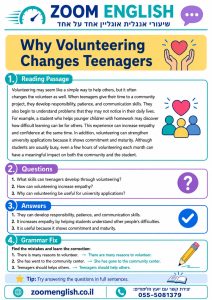

140 שאלות אמריקאיות בהבנת הנקרא באנגלית ברמה בינונית: קטעים, תשובות ושיטת פתרון
הקושי הזה אינו מעיד בהכרח על אנגלית חלשה. לעיתים התלמיד קורא ברמה טובה, אך עדיין לא פיתח שיטה מסודרת להבחין בין עובדה, מסקנה, רעיון מרכזי ודעה. הוא מחפש התאמה מילולית במקום התאמה במשמעות, קורא כל משפט באותה רמת חשיבות או בוחר תשובה שנשמעת הגיונית בחיים — אף שהיא אינה נתמכת בטקסט. כך אפשר לדעת הרבה מילים ולהמשיך לאבד נקודות בשאלות אמריקאיות.
התרגול שלפניכם נועד לשנות את דרך העבודה הזאת. הוא כולל ארבעה־עשר קטעי קריאה מקוריים באנגלית ברמה בינונית ו־140 שאלות אמריקאיות. השאלות אינן בודקות רק אם מצאתם מילה מסוימת. הן דורשות מכם להבין מה קרה, למה זה קרה, כיצד הכותב מציג את הנושא, מה ניתן להסיק, מה פירושה של מילה בתוך המשפט ואיזו תשובה היא “כמעט נכונה” אך כוללת פרט שאינו מופיע.

אפשר להשתמש במדריך כתלמידי חטיבת ביניים ותיכון, כהכנה הדרגתית לאנסין, כחיזוק לסטודנטים ולמבוגרים שחזרו ללמוד אנגלית, או כתרגול למי שזקוקים לקריאה באנגלית בעבודה. הורים יכולים להשתמש בו כדי לזהות היכן הילד נתקע באמת: בקריאת המילים, בהבנת המשפט, באוצר המילים, בניהול הזמן או בפענוח השאלה.
אל תנסו לסיים את כל 140 השאלות בישיבה אחת. המטרה אינה לצבור תשובות אלא ללמוד מן ההחלטות שקיבלתם. עשרה תרגילים שבהם ניתחתם היטב מדוע שלוש אפשרויות שגויות יכולים לתרום יותר מחמישים תרגילים שנפתרו במהירות בלי לבדוק את דרך החשיבה.
כאשר תלמיד עובד עם מורה פרטי לאנגלית אונליין, אותו תרגיל יכול להפוך מכלי מדידה לכלי למידה. המורה אינו מסתפק באמירה “התשובה היא ב׳”, אלא בודק מדוע התלמיד בחר אחרת. ייתכן שהוא לא הבין מילת קישור, התעלם משלילה, פירש כינוי גוף בצורה שגויה או בחר תשובה כללית מדי. האבחון הזה מאפשר לבנות תרגול ממוקד במקום לתת עוד ועוד דפי עבודה זהים.
השאלה לא בודקת רק אם הבנתם את המילים
תלמידים רבים ניגשים להבנת הנקרא כאילו מדובר במבחן אוצר מילים. הם מאמינים שאם יצליחו לתרגם את רוב המילים, התשובות יופיעו מעצמן. התרגום אכן יכול לעזור, אך הוא אינו מספיק. אפשר להבין כל מילה במשפט ועדיין לפספס את הקשר בין שני משפטים, את הסיבה להחלטה מסוימת או את הנימה שבה הכותב מציג אותה.
קריאה טובה היא פעולה של בניית משמעות. הקורא מחבר מידע חדש למידע שכבר קרא, מבחין בין עיקר לטפל, עוקב אחר כינויים כמו it, they, this, ומבין כיצד מילים כמו however, therefore, although משנות את היחסים בין הרעיונות. תהליך זה פעיל הרבה יותר מחיפוש תרגום מילולי.
גם אופי השאלה משפיע על רמת הקושי. אותו קטע יכול להיות קל כאשר שואלים “באיזו שעה נפתחה הספרייה?”, וקשה כאשר שואלים “מדוע לדעתכם שינתה הספרייה את שעות הפעילות?”. מועצת אירופה מציינת בעמוד העוסק בהערכת הבנת הנקרא כי קושי המשימה מושפע הן ממאפייני הטקסט והן ממאפייני השאלות הנלוות אליו.
השאלות האמריקאיות מוסיפות שכבה נוספת: אינכם נדרשים רק למצוא את התשובה, אלא גם לדחות שלוש תשובות מתחרות. חלקן יכילו מילים מתוך הקטע. אחרות יהיו נכונות באופן כללי אך לא יענו על השאלה המדויקת. תשובה נוספת עשויה להיות נכונה בחלקה, אך לכלול מילה קיצונית כמו “תמיד”, “רק” או “כל”.
הטעות הנפוצה היא להפסיק לקרוא ברגע שאפשרות אחת נראית מתאימה. קורא מיומן עושה פעולה הפוכה: הוא בודק איזו אפשרות נתמכת בצורה הטובה ביותר, ואחר כך מנסה להפריך אותה. אם קיימת מילה אחת שאינה תואמת לטקסט, האפשרות כולה עלולה להיות שגויה.
התעלמות מההבדל הזה יוצרת תסכול מצטבר. תלמיד יכול לתרגל במשך חודשים ולחשוב שהוא “לא טוב באנסין”, כאשר למעשה הוא חוזר שוב ושוב על אותה אסטרטגיה לא יעילה. בשיעור אנגלית אישי אפשר לעצור את התהליך, לחשוב בקול ולגלות באיזה שלב התקבלה ההחלטה השגויה.
מה בודקות שאלות אמריקאיות ברמת ביניים?
ברמת ביניים לא מצפים מהקורא להבין כל ביטוי נדיר. מצפים ממנו להתמודד עם טקסטים ברורים בנושאים יומיומיים, לימודיים ותעסוקתיים, ולהפיק מהם משמעות שימושית. בחינת הקריאה של Cambridge ברמת B1, למשל, כוללת משימות הבודקות רעיון כללי, הבנה מפורטת, הסקה, משמעות כוללת ודעת הכותב. ניתן לראות את חלוקת המיומנויות בעמוד הרשמי של מבנה בחינת B1 Preliminary.
שאלת רעיון מרכזי דורשת מכם להתרחק מן הפרטים ולשאול מהו החוט המחבר ביניהם. אם הטקסט מספר על עובדת שעברה לעבודה מהבית, על היתרונות שמצאה ועל הקושי להציב גבולות, הרעיון המרכזי אינו “היא חסכה זמן נסיעה”. זהו פרט אחד. הרעיון הרחב יותר עוסק בשינוי שיטת העבודה ובהסתגלות שנדרשה.
שאלת מידע מפורש נראית קלה, אך היא מסוכנת כאשר אפשרויות התשובה משנות פרט קטן. הטקסט עשוי לומר שהאירוע מתחיל ביום חמישי בשעה שש, ואפשרות מבלבלת תציין שהוא מתקיים ביום שישי בשש. מי שקורא במהירות זוכר את השעה אך לא את היום.
שאלת הסקה מבקשת להבין דבר שהכותב לא אמר ישירות, אך סיפק מספיק ראיות כדי להסיק אותו. אם אדם יצא מהבית עם מטרייה, נעליים אטומות ומעיל, אפשר להסיק שהוא ציפה למזג אוויר גשום. אי אפשר להסיק שהוא שונא את החורף, משום שאין לכך תמיכה.
שאלת אוצר מילים בהקשר אינה שואלת מהו התרגום היחיד של המילה במילון. היא בודקת איזה פירוש מתאים למשפט המסוים. המילה light יכולה להתייחס לאור, למשקל נמוך או לצבע בהיר. המשפט והרעיון שסביבו קובעים את המשמעות.
שאלת מטרת הכותב או יחסו לנושא דורשת לשים לב לבחירת המילים. האם הכותב ממליץ, מזהיר, משווה, מבקר או רק מדווח? תלמידים רבים בוחרים תשובה דרמטית מדי. טקסט המציג שני יתרונות וחיסרון אחד אינו בהכרח “מתנגד” לרעיון; ייתכן שהוא מציג תמונה מאוזנת.
שיטת עבודה לפני שמתחילים את 140 השאלות
בקריאה הראשונה אל תעצרו בכל מילה שאינכם מכירים. קראו את הכותרת ואת הפסקה הראשונה, נסו להבין מי מעורב, מה הנושא ומה השתנה. אחר כך המשיכו עד סוף הקטע וסמנו בראשכם את התפקיד של כל פסקה: הצגת מצב, הסבר, דוגמה, קושי, תוצאה או מסקנה.
לפני שאתם בוחנים את האפשרויות, קראו את השאלה ונסחו תשובה קצרה במילים שלכם. אין צורך במשפט מושלם באנגלית. אפילו תשובה פנימית בעברית יכולה למנוע מן המסיחים להשפיע עליכם. רק לאחר מכן השוו את הרעיון שלכם לארבע האפשרויות.
כאשר השאלה מתייחסת לפרט, חזרו לאזור המתאים בטקסט. אל תסתמכו רק על הזיכרון. קראו לפחות משפט אחד לפני המידע ומשפט אחד אחריו. לעיתים המשפט הבא כולל מילת ניגוד שהופכת את המשמעות: “היא תכננה להגיע, אך נאלצה לבטל”.
סמנו מילות מגבלה באפשרויות: always, never, only, all, completely, immediately. מילים אלה אינן בהכרח שגויות, אך הן דורשות הוכחה חזקה. אם הטקסט אומר “חלק מהתלמידים התקשו”, תשובה הטוענת ש“כל התלמידים התקשו” אינה נתמכת.
בדקו את כל האפשרויות גם כאשר הראשונה נראית נכונה. בשאלות ברמה בינונית, שתי אפשרויות עשויות להישמע סבירות. ההבדל יהיה לעיתים במילת יחס, בזמן הפועל, בזהות האדם או בשאלה אם מדובר בסיבה, בתוצאה או בדוגמה.
לאחר הבדיקה אל תסתפקו בציון. חלקו את הטעויות לקטגוריות. כתבו ליד כל שאלה: “לא הבנתי את השאלה”, “לא מצאתי את המקום בטקסט”, “התפתיתי למילה זהה”, “לא הכרתי מילת קישור”, “הסקתי יותר מדי” או “מיהרתי”. זהו מידע חשוב יותר ממספר התשובות הנכונות.
טיפ מעשי: פתרו בכל פעם קטע אחד בלבד, בלי מילון ובזמן מוגדר. לאחר מכן עברו עליו שוב ללא לחץ, בדקו מילים וחפשו ראיות. ההשוואה בין הקריאה הראשונה לשנייה תראה אם הבעיה נובעת מרמת האנגלית, מניהול הזמן או מאסטרטגיית הפתרון.
140 שאלות אמריקאיות בהבנת הנקרא באנגלית ברמה בינונית
ארבעה־עשר הקטעים הבאים מדורגים באופן כללי סביב רמת ביניים, אך הקושי אינו זהה בכל שאלה. חלק מהטקסטים ירגישו פשוטים מבחינת אוצר המילים, ובכל זאת יכללו שאלות הסקה מאתגרות. אחרים יכילו מילים פחות מוכרות שאפשר להבין מתוך ההקשר.
מומלץ לכתוב את התשובות על דף נפרד ולא לפתוח מיד את מפתח התשובות. ליד כל בחירה כתבו מספר שורה, ביטוי או משפט התומכים בה. אם אינכם מסוגלים להצביע על ראיה, ייתכן שבחרתם לפי תחושה ולא לפי הטקסט.
אין צורך לתרגם את הקטעים לעברית. התרגום המלא גוזל זמן ולעיתים אף מסתיר את המבנה. חפשו את הדמויות, הפעולות, הסיבות, התוצאות ומילות הקישור. המטרה היא להבין את המסר, לא לייצר תרגום ספרותי.
הקטעים עוסקים בבית הספר, קהילה, עבודה, נסיעות, קניות, התנדבות, טכנולוגיה ולימוד שפה. המגוון נועד לבדוק האם אתם מסוגלים להעביר את מיומנות הקריאה מנושא מוכר לנושא חדש.
לאחר כל קטע עצרו לרגע ושאלו: איזה סוג שאלה היה הקשה ביותר? תלמיד שמצליח בשאלות פרטים אך מתקשה ברעיון מרכזי זקוק לאימון אחר מתלמיד שמבין את הסיפור אך נתקע באוצר מילים.
אם אתם עובדים עם מורה לאנגלית בזום, קראו חלק מן הקטע בקול והסבירו באנגלית פשוטה מדוע בחרתם בתשובה. כך תרגיל הבנת הנקרא מחזק גם הגייה, דיבור, ניסוח והיכולת להצדיק דעה.
קטע 1: The Quiet Hour
Westfield School recently introduced a “quiet hour” in its library every Tuesday and Thursday afternoon. During this time, students may read, complete homework, or prepare for tests, but they must keep their phones inside their bags and avoid unnecessary conversation.
The idea came from the school librarian, Mrs Evans, who noticed that many students wanted a calm place to work after lessons. The school café was usually crowded, while some students found it difficult to concentrate at home because they shared rooms with younger brothers or sisters.
At first, several students thought the new rule would make the library feel unfriendly. However, attendance during quiet hour increased steadily. Maya, a Year 9 student, began using the time to finish a science project. She said that forty minutes of focused work in the library often saved her more than an hour at home.
The library still allows group work at other times. Mrs Evans explains that the quiet hour is not a punishment and is not intended to replace social activities. It simply gives students another choice. The school plans to review the programme at the end of the term and may add a third afternoon if demand remains high.
- What is the main purpose of the text?
- A. To complain about noise in a school café
- B. To describe a new library programme and its results
- C. To explain why students should stop using phones
- D. To compare two different schools
- Why did Mrs Evans suggest the quiet hour?
- A. Students had damaged library books.
- B. Teachers needed a room for meetings.
- C. Students needed a peaceful place to study.
- D. The café was closing permanently.
- What must students do during quiet hour?
- A. Keep their phones in their bags.
- B. Read only school textbooks.
- C. Work on science projects.
- D. Leave after forty minutes.
- Why was studying at home difficult for some students?
- A. They did not own computers.
- B. They shared space with younger family members.
- C. Their parents did not allow homework.
- D. They lived far from school.
- How did some students feel before the programme began?
- A. Excited about meeting new people
- B. Worried that the library would close
- C. Concerned that the atmosphere might feel unfriendly
- D. Certain that nobody would attend
- What did Maya discover?
- A. Science was easier than she expected.
- B. Focused library work helped her use time efficiently.
- C. Homework should always be completed alone.
- D. The café was quieter on Tuesdays.
- The word “steadily” is closest in meaning to:
- A. gradually and continuously
- B. suddenly and unexpectedly
- C. rarely
- D. secretly
- What can students do outside quiet hour?
- A. Use the library only for reading
- B. Borrow phones from the librarian
- C. Work together in groups
- D. Eat meals inside the library
- Why does Mrs Evans say the programme offers “another choice”?
- A. Students may choose their school subjects.
- B. Students can select a quiet environment when they need it.
- C. Students can decide whether the library opens.
- D. Students may replace homework with social activities.
- What may happen next term?
- A. Quiet hour may be offered on another afternoon.
- B. The school café may become a library.
- C. Group work may be permanently banned.
- D. Maya may manage the programme.
קטע 2: A Garden Between Buildings
For years, the empty space between two apartment buildings on Nelson Street collected rubbish and rainwater. Most residents walked past it without paying attention. Last spring, a small group suggested turning the area into a community garden.
The plan sounded simple, but the group first had to speak to the building owners, check the soil and arrange insurance. They also asked residents what they wanted to grow. Older neighbours preferred herbs and vegetables, while families with young children requested flowers and a small path where children could explore safely.
Work began in April. Volunteers removed rubbish, built wooden planting boxes and collected rainwater in covered containers. A nearby restaurant donated vegetable seeds, and a local carpenter repaired an old bench without charging the group.
The garden has not solved every local problem. People still disagree about watering duties, and some plants have been damaged by unusually hot weather. Nevertheless, the space has changed how neighbours interact. Residents who had lived in the same buildings for years without speaking now exchange gardening advice and share extra vegetables.
The organisers are careful not to describe the project as finished. Their next goal is to make one planting box accessible to people who cannot bend down easily. They are also planning short gardening sessions for beginners.
- What was the area like before the project?
- A. It was a popular playground.
- B. It belonged to a restaurant.
- C. It was neglected and collected waste.
- D. It contained private vegetable gardens.
- What did the organisers do before starting work?
- A. They sold vegetables to raise money.
- B. They dealt with practical and legal arrangements.
- C. They hired professional gardeners.
- D. They closed the path between the buildings.
- What did families with children request?
- A. Flowers and a safe path
- B. A larger car park
- C. Only herbs and vegetables
- D. A restaurant seating area
- Which task was NOT mentioned?
- A. Removing rubbish
- B. Building planting boxes
- C. Collecting rainwater
- D. Installing electric lighting
- How did the restaurant support the project?
- A. It provided free meals.
- B. It gave the group seeds.
- C. It employed the volunteers.
- D. It paid for the insurance.
- What problem remains?
- A. Nobody wants to use the garden.
- B. The owners want the land back immediately.
- C. Residents do not always agree about responsibilities.
- D. Children are not allowed to enter.
- What has been an important social result?
- A. Neighbours communicate more than before.
- B. More people have moved into the buildings.
- C. The restaurant has become more profitable.
- D. Residents no longer buy food.
- The word “accessible” most nearly means:
- A. expensive to maintain
- B. easy for different people to use
- C. protected from hot weather
- D. available only to organisers
- Why do the organisers avoid calling the garden finished?
- A. They expect the owners to cancel it.
- B. They are disappointed with the vegetables.
- C. They want to move it elsewhere.
- D. They still have improvements and activities planned.
- Which statement best describes the writer’s view?
- A. The project failed because of disagreements.
- B. Gardening is suitable only for older people.
- C. The garden is valuable despite continuing challenges.
- D. The project should have been managed by professionals.
קטע 3: Two Days at Home
When a design company introduced a two-day work-from-home policy, employee Daniel expected his productivity to improve immediately. He imagined quiet mornings, fewer interruptions and extra time because he would not need to travel across the city.
During the first week, however, Daniel found himself checking messages constantly. Because his laptop was always nearby, he began work earlier and continued answering emails after dinner. He also missed the short conversations with colleagues that often helped him solve problems quickly.
Instead of deciding that remote work was unsuitable, Daniel changed his routine. He created a specific working area in the corner of his living room, turned off non-urgent notifications and added two short online check-ins with his team. Most importantly, he began closing his laptop at a fixed time.
After a month, Daniel felt more organised. He used home days for tasks requiring concentration and office days for meetings, feedback and collaborative work. His manager noticed that projects were being completed more consistently, although Daniel did not necessarily work faster.
Daniel now says the main advantage of working from home is not simply comfort. It is the ability to plan different kinds of work in environments that support them. He also warns new remote workers that flexibility without boundaries can easily become a longer working day.
- What did Daniel originally expect?
- A. To attend more meetings
- B. To become productive immediately
- C. To move to another city
- D. To stop communicating with colleagues
- What difficulty appeared during the first week?
- A. His internet stopped working.
- B. His manager gave him fewer projects.
- C. Work began to spread into his personal time.
- D. His colleagues refused to answer messages.
- Why did Daniel miss informal conversations?
- A. They sometimes helped him find solutions.
- B. They made the working day shorter.
- C. They replaced formal meetings completely.
- D. They allowed him to avoid difficult tasks.
- Which change did Daniel NOT make?
- A. Creating a work area
- B. Reducing notifications
- C. Scheduling team contact
- D. Buying a larger home
- What was especially important in improving his routine?
- A. Starting before everyone else
- B. Ending work at a set time
- C. Answering every message immediately
- D. Avoiding the office
- How did Daniel divide his tasks?
- A. Concentrated work at home and collaboration at the office
- B. All difficult work at the office
- C. Meetings at home and quiet work in cafés
- D. Personal tasks during office days
- What did his manager observe?
- A. Daniel worked more hours than everyone else.
- B. Daniel completed every project early.
- C. Daniel’s work became more consistent.
- D. Daniel no longer needed feedback.
- The word “boundaries” refers to:
- A. walls between rooms
- B. clear limits between work and personal time
- C. rules about travelling
- D. differences between employees
- What can be inferred about Daniel’s attitude?
- A. He believes remote work is always easier.
- B. He wants to work from home every day.
- C. He thinks office work has no value.
- D. He supports remote work when it is managed carefully.
- What is the main message?
- A. Employees should work longer at home.
- B. Online meetings are better than conversations.
- C. Flexible work is effective when routines match the task.
- D. Travelling to work prevents productivity.
קטע 4: The Repair Café
On the first Saturday of each month, a community hall in Greenford becomes a repair café. People bring broken lamps, small kitchen appliances, clothes and bicycles. Volunteers examine the items and try to repair them while their owners watch and learn.
The café was created after local residents noticed how many useful objects were being thrown away because of minor faults. A loose wire, missing button or damaged cable often made an item seem unusable, even though the repair might take only a few minutes.
Visitors do not pay a fixed fee, but donations help cover the cost of tools and replacement materials. The volunteers cannot guarantee that every object will be saved. They also refuse to open equipment that could be dangerous without specialist training.
One visitor, Hassan, brought an old radio that had belonged to his grandfather. A volunteer cleaned a connection and replaced a small part. When the radio began working, Hassan said its personal value was much greater than the price of a new one.
The organisers believe the café is about more than reducing waste. It gives people practical knowledge and creates conversations between residents of different ages. Experienced volunteers often explain each step rather than completing the job silently. As a result, some regular visitors have begun repairing simple items at home.
- What happens at the repair café?
- A. New products are sold cheaply.
- B. Volunteers help people repair damaged items.
- C. Specialists collect dangerous equipment.
- D. Residents exchange furniture.
- Why was the café established?
- A. The community hall needed income.
- B. Volunteers wanted to sell tools.
- C. Many repairable objects were being discarded.
- D. Local shops had stopped selling appliances.
- How is the café mainly funded?
- A. Through voluntary donations
- B. Through a required entrance fee
- C. By selling repaired bicycles
- D. By the owners of appliance shops
- Which item might volunteers refuse to examine?
- A. A shirt with a missing button
- B. A bicycle with a loose seat
- C. A lamp needing a simple cable
- D. Equipment requiring specialist safety knowledge
- Why was Hassan’s radio important to him?
- A. It was extremely expensive.
- B. It had a family connection.
- C. He needed it for his job.
- D. It was the café’s first repair.
- What do experienced volunteers often do?
- A. Ask owners to leave the room
- B. Complete repairs without speaking
- C. Explain the repair process
- D. Sell replacement products
- The word “faults” is closest in meaning to:
- A. problems or defects
- B. prices
- C. instructions
- D. arguments
- What have some regular visitors learned?
- A. How to organise a café
- B. How to perform basic repairs themselves
- C. How to manufacture appliances
- D. How to avoid using tools
- What can be inferred about the organisers?
- A. They believe all broken items must be saved.
- B. They care mainly about making money.
- C. They prefer working only with young people.
- D. They value environmental and social benefits.
- Which title best fits the text?
- A. Why New Products Are Safer
- B. The Most Expensive Radio in Greenford
- C. Repairing Objects and Building Community
- D. How to Open an Appliance Store
קטע 5: Learning Through Short Podcasts
Lina wanted to improve her English listening, so she downloaded several hour-long podcasts. She listened while travelling to work, but after a few days she realised that her attention often disappeared after the first ten minutes. She heard the sounds without following the ideas.
Her tutor suggested choosing shorter episodes and listening to each one more than once. During the first listening, Lina focused only on the general topic. During the second, she wrote down key words and tried to identify examples. Finally, she checked a transcript and listened again to the difficult sections.
At first, Lina worried that repeating the same material was less useful than hearing something new every day. However, she soon noticed details she had missed before. She also began recognising common phrases as complete units instead of translating each word separately.
After several weeks, Lina returned to a longer podcast. She still did not understand everything, but she could follow the structure and notice when the speaker introduced a contrasting opinion or gave a conclusion.
Lina’s progress did not come from listening for more hours. It came from giving a clear purpose to each listening. She now chooses material that is challenging but not overwhelming and keeps a short list of expressions she wants to use in conversation.
- What problem did Lina have with long podcasts?
- A. They used no useful vocabulary.
- B. She stopped concentrating after a short time.
- C. She could not download them.
- D. They were available only at work.
- What did her tutor recommend first?
- A. Selecting shorter episodes
- B. Translating every sentence
- C. Listening only at home
- D. Avoiding transcripts
- What was Lina’s goal during the first listening?
- A. To memorise every expression
- B. To write a complete summary
- C. To understand the general subject
- D. To identify grammar mistakes
- When did she use the transcript?
- A. Before hearing the episode
- B. Instead of listening
- C. During her journey to work
- D. After listening more than once
- Why did Lina originally doubt repetition?
- A. She disliked the speakers.
- B. She thought new material might be more valuable.
- C. Her tutor had forbidden it.
- D. The episodes became unavailable.
- What improvement did she notice?
- A. She could translate faster into Hebrew.
- B. She no longer needed to learn vocabulary.
- C. She began recognising groups of words naturally.
- D. She understood every podcast completely.
- What could Lina do when she returned to longer material?
- A. Follow the organisation of the discussion
- B. Remember every detail after one listening
- C. Speak as quickly as the presenter
- D. Avoid unfamiliar opinions
- The word “overwhelming” most nearly means:
- A. amusing
- B. familiar
- C. too short
- D. too difficult to manage comfortably
- According to the text, what caused Lina’s progress?
- A. Listening for many additional hours
- B. Listening with a different purpose each time
- C. Choosing only easy material
- D. Studying without a tutor
- What does Lina now do with useful expressions?
- A. Deletes them after the episode
- B. Translates them into several languages
- C. Records them for future speaking practice
- D. Uses them only in written tests
קטע 6: A New Bus Route
The town of Bellford changed one of its bus routes after receiving complaints from residents in the northern neighbourhoods. The old route travelled directly to the shopping centre but did not stop near the health clinic or the new employment area.
Transport planners proposed adding both locations. This made the journey nine minutes longer, and some regular passengers objected. They argued that the service had become slower for people who simply wanted to reach the town centre.
During a six-week trial, passenger numbers increased, particularly between nine in the morning and three in the afternoon. Clinic staff reported that fewer patients arrived late, while several businesses said the route made it easier for employees without cars to reach work.
The council decided to keep the new route but made one adjustment. During the busiest morning period, two buses now follow the shorter route, while later services include the clinic and employment area. Officials say the arrangement is not perfect, but it balances the needs of different passengers more successfully.
The council will examine ticket data again after six months. It has also invited passengers to report missed connections, overcrowding and other problems through an online form or by telephone.
- Why was the route changed?
- A. The shopping centre had closed.
- B. The council wanted to reduce all journeys.
- C. Important destinations were not served.
- D. The buses were too old.
- Why did some regular passengers complain?
- A. Ticket prices increased.
- B. Their journey became longer.
- C. Buses stopped running in the morning.
- D. The employment area was removed.
- What happened during the trial?
- A. More people used the service.
- B. The clinic lost patients.
- C. Businesses provided free cars.
- D. The route became nine minutes shorter.
- Which group particularly benefited from the employment-area stop?
- A. Tourists visiting the town
- B. People shopping in the evening
- C. Bus drivers living in the north
- D. Workers who did not have cars
- What adjustment did the council make?
- A. It removed the clinic stop.
- B. It cancelled afternoon buses.
- C. It provided some shorter morning services.
- D. It opened a new shopping centre.
- Why does the council describe the arrangement as a balance?
- A. Every passenger now has the same journey.
- B. It attempts to serve different needs at different times.
- C. All services take exactly nine minutes.
- D. Passengers vote on each route.
- The word “trial” means:
- A. a temporary test period
- B. a legal case
- C. a passenger complaint
- D. a final permanent decision
- What will officials use to review the service?
- A. Interviews with shop owners only
- B. Weather reports
- C. Ticket information and passenger feedback
- D. The number of private cars
- Which statement is supported by the text?
- A. Every passenger preferred the new route.
- B. The council ignored the trial results.
- C. Passenger numbers decreased at midday.
- D. The change produced benefits as well as disadvantages.
- What is the writer mainly describing?
- A. Why public transport should be free
- B. How a town responded to competing transport needs
- C. Why health clinics should move
- D. How to complete an online form
קטע 7: The Uniform Exchange
When her son grew out of two school jumpers after only one term, Priya placed them in a cupboard. They were still in good condition, but she did not know anyone who needed the same size. A few months later, she heard that the school was creating a uniform exchange.
Families could donate clean items that no longer fitted. Volunteers checked each piece, sorted it by size and displayed it during monthly collection afternoons. Parents could take the clothes they needed without proving financial difficulty or explaining their circumstances.
The school deliberately avoided calling the event a charity sale. Organisers wanted second-hand uniforms to feel like a normal, practical choice rather than a sign that a family could not afford new clothing. Some parents donated money, but payment was optional.
The exchange reduced waste and helped families whose children grew quickly. It also revealed a problem: certain sizes were always available, while larger sports clothes were in short supply. The school therefore added an online list showing which items were most urgently needed.
Priya donated the two jumpers and later found a nearly new sports jacket for her son. She appreciated the financial saving, but she was equally pleased that useful clothes were being worn instead of forgotten in cupboards.
- Why had Priya kept the jumpers?
- A. Her son still wore them.
- B. They were usable, but she had no one to give them to.
- C. The school required her to store them.
- D. She planned to sell them online.
- What did volunteers do?
- A. Repaired every donated item
- B. Visited families at home
- C. Checked and organised the clothing
- D. Set a fixed price for each piece
- What were parents NOT required to do?
- A. Demonstrate that they needed financial help
- B. Attend the school
- C. Choose the correct size
- D. Collect items during opening times
- Why was the phrase “charity sale” avoided?
- A. The school planned to make a profit.
- B. The clothes were all new.
- C. Sales were forbidden.
- D. Organisers wanted the exchange to feel normal and inclusive.
- What was optional?
- A. Cleaning donated clothes
- B. Making a payment
- C. Sorting items by size
- D. Using the collection afternoon
- What problem did the exchange discover?
- A. Nobody wanted jumpers.
- B. Families donated damaged clothes.
- C. Supply did not match demand in every size.
- D. The school had no storage space.
- Why was an online list introduced?
- A. To show which clothing was especially needed
- B. To identify families taking free items
- C. To replace all collection afternoons
- D. To advertise new uniforms
- The phrase “in short supply” means:
- A. too expensive
- B. badly designed
- C. available in small sizes
- D. not available in sufficient quantities
- What pleased Priya besides saving money?
- A. Her son received two new jumpers.
- B. Clothes were being reused.
- C. She became a paid volunteer.
- D. The school changed its uniform.
- What is the central idea of the text?
- A. Children should wear larger uniforms.
- B. Schools should stop requiring sports clothes.
- C. A practical exchange can reduce cost, waste and embarrassment.
- D. Online shopping is the best way to buy uniforms.
קטע 8: The Saturday Walking Group
After moving to a new town, Elena joined a Saturday walking group because she wanted to meet people. The group’s website described the walks as suitable for beginners, so she expected a relaxed hour in a local park.
Her first walk was longer than expected and included a steep hill. Elena managed to finish, but she felt uncomfortable because she was slower than several experienced members. She considered not returning.
A group leader called Marcus noticed her concern. He explained that the website had not been updated after the route changed. He also told her that the group used a “back marker”: a volunteer who remained with the final walkers so nobody had to walk alone.
The following week, Marcus organised two route options. Both groups began and ended at the same café, but one followed a shorter, flatter path. Elena chose that route and found it easier to talk to other participants because she was no longer worried about keeping up.
The group has since improved its online descriptions. Each walk now includes distance, expected time, surface type and difficulty. Elena still sometimes selects the shorter route, but she has gradually attempted longer walks. She says accurate information did more to welcome her than simply describing every activity as suitable for everyone.
- Why did Elena join the group?
- A. To train for a competition
- B. To find a new job
- C. To meet people after moving
- D. To learn how to use a map
- Why was her first experience difficult?
- A. The group did not meet.
- B. The route was harder than the description suggested.
- C. She forgot her walking shoes.
- D. The café was closed.
- What did Elena think about doing?
- A. Leaving the group permanently
- B. Becoming the group leader
- C. Updating the website herself
- D. Choosing a steeper route
- What is the role of the “back marker”?
- A. To choose the fastest walkers
- B. To close the café
- C. To measure the route
- D. To stay with people at the back
- What did Marcus organise the next week?
- A. A walking competition
- B. A private lesson for Elena
- C. Two routes with different difficulty levels
- D. A meeting without a walk
- Why could Elena talk more easily on the second walk?
- A. She already knew every participant.
- B. She was less concerned about walking speed.
- C. The group remained inside the café.
- D. Marcus translated the conversations.
- What information is now included online?
- A. Practical details about each route
- B. Participants’ private phone numbers
- C. The price of walking equipment
- D. A list of the fastest walkers
- The word “gradually” means:
- A. without success
- B. immediately
- C. by accident
- D. little by little
- What does Elena believe makes an activity welcoming?
- A. Calling every route easy
- B. Allowing only beginners to attend
- C. Giving people honest information so they can choose
- D. Making all participants walk at the same speed
- Which lesson can be learned from the text?
- A. Beginners should avoid group activities.
- B. Inclusion requires practical planning, not only friendly words.
- C. Longer walks are always more social.
- D. Websites should contain as little information as possible.
קטע 9: Listening to Customer Questions
Amir runs a small online shop selling handmade desk accessories. For months, he received messages asking whether his wooden laptop stands could hold heavier computers. He answered each customer separately but did not change the product page.
After one customer decided not to order because the information was unclear, Amir reviewed twenty recent messages. He discovered that many people were asking the same three questions: maximum weight, delivery time and whether the stand could be folded.
Amir photographed the folding mechanism, added the weight limit and created a simple delivery table. The number of messages fell, but sales increased slightly. Customers were able to make decisions without waiting for a reply.
Amir initially worried that publishing limits might reduce sales. For example, one large computer was too heavy for the stand. However, he realised that an unsuitable sale often led to returns, complaints and disappointed customers. Clear information attracted fewer unsuitable buyers and more confident suitable ones.
He now records repeated questions in a document and reviews it every month. He does not automatically follow every suggestion. Instead, he looks for patterns that reveal missing information or unnecessary difficulty in the buying process.
- What mistake did Amir make at first?
- A. He stopped answering customers.
- B. He repeatedly answered questions without improving the page.
- C. He sold products only in a physical shop.
- D. He removed the laptop stands.
- What caused him to review the messages?
- A. A delivery company contacted him.
- B. He received a new computer.
- C. Unclear information contributed to a lost sale.
- D. Customers demanded lower prices.
- Which detail did customers frequently request?
- A. The product’s maximum weight
- B. Amir’s home address
- C. The type of camera he used
- D. The number of employees
- Which action was NOT mentioned?
- A. Adding photographs
- B. Publishing a weight limit
- C. Creating delivery information
- D. Changing the stand’s price
- What happened after the page was improved?
- A. Messages and sales both disappeared.
- B. Fewer questions were sent, while sales rose slightly.
- C. Every visitor bought a stand.
- D. Delivery became free.
- Why had Amir been nervous about publishing limits?
- A. He thought competitors would copy him.
- B. The information was difficult to measure.
- C. Some potential customers might discover the product was unsuitable.
- D. He wanted customers to telephone him.
- What did Amir learn about unsuitable sales?
- A. They can create further problems after purchase.
- B. They are more profitable.
- C. They improve customer confidence.
- D. They remove the need for product information.
- The word “patterns” refers to:
- A. decorative designs on the stands
- B. delivery routes
- C. monthly sales targets
- D. repeated themes or behaviours
- How does Amir use customer suggestions now?
- A. He accepts every suggestion immediately.
- B. He examines repeated feedback for useful signals.
- C. He shares private messages publicly.
- D. He ignores questions about delivery.
- What is the main lesson?
- A. Small businesses should avoid product limits.
- B. Customers prefer asking questions to reading.
- C. Clear information can reduce uncertainty and improve decisions.
- D. Handmade products cannot be sold online.
קטע 10: Volunteering at the Animal Centre
Sixteen-year-old Noah applied to volunteer at a local animal centre because he enjoyed spending time with dogs. He imagined that most of his work would involve walking them and playing with them outdoors.
During his introductory session, the coordinator explained that volunteers also cleaned bowls, folded blankets, prepared food and updated information cards. Noah was disappointed by the amount of routine work, but he agreed to attend for four Saturdays before making a decision.
On his second week, Noah noticed that one nervous dog refused to eat when strangers stood nearby. He began preparing the food and then moving quietly to the other side of the room. After several visits, the dog became calmer and eventually ate while Noah remained nearby.
Noah realised that caring for animals often meant observing small changes rather than expecting immediate affection. The cleaning and record-keeping also helped staff notice whether an animal’s behaviour, appetite or health had changed.
At the end of the four weeks, Noah chose to continue. He still enjoys dog walking, but he no longer sees the less exciting tasks as unimportant. He is considering studying animal care and says the experience gave him a more realistic understanding of the work.
- Why did Noah first apply?
- A. He needed to earn money.
- B. His school required it.
- C. He liked being with dogs.
- D. He wanted to clean equipment.
- Why was Noah initially disappointed?
- A. He was not allowed near animals.
- B. The role included more routine duties than expected.
- C. The centre closed on Saturdays.
- D. He had to study for an examination.
- What did he agree to do?
- A. Try the role for four Saturdays
- B. Volunteer every day
- C. Work only with one dog
- D. Prepare a school report
- How did Noah help the nervous dog?
- A. He took it outside immediately.
- B. He changed its food every week.
- C. He invited more people into the room.
- D. He gave it space and behaved calmly.
- What did the dog eventually do?
- A. Leave the centre
- B. Walk with several strangers
- C. Eat while Noah was still nearby
- D. Refuse all prepared food
- What did Noah learn about animal care?
- A. Animals always show affection quickly.
- B. Small observations and patient actions matter.
- C. Cleaning is unrelated to health.
- D. Only trained vets can notice changes.
- Why are records useful?
- A. They help staff identify changes over time.
- B. They advertise the centre.
- C. They replace feeding duties.
- D. They allow volunteers to work from home.
- The phrase “realistic understanding” suggests that Noah:
- A. now believes the work is easy
- B. wants to avoid animals
- C. expects only enjoyable duties
- D. understands both attractive and routine parts of the job
- What can be inferred about Noah?
- A. He gave up when the role differed from his expectations.
- B. He refused to perform cleaning tasks.
- C. His attitude became more mature through experience.
- D. He plans to open a centre immediately.
- Which title best fits the text?
- A. Four Saturdays Without Dogs
- B. Discovering What Animal Care Really Involves
- C. Why Teenagers Should Not Volunteer
- D. The Fastest Way to Train a Nervous Dog
קטע 11: Wednesday Without Screens
The Cohen family introduced a screen-free period every Wednesday from seven until nine in the evening. The decision followed several dinners during which everyone continued checking phones, answering messages or watching short videos.
The first Wednesday was uncomfortable. The children complained that they had nothing to do, while their father repeatedly reached toward the place where he usually left his phone. The family attempted a board game, but an argument began over the rules.
Instead of cancelling the experiment, they changed it. Each family member wrote two activity ideas on pieces of paper. Suggestions included cooking dessert, walking, drawing, playing cards and planning a weekend trip. One paper was selected each Wednesday, although nobody was forced to join every activity.
After a month, the family did not claim that screens were harmful or unnecessary. They still used them for homework, work, entertainment and communication. The Wednesday routine simply made them more aware of automatic habits.
Their mother noticed that conversations often continued after nine, even when phones were returned. The children admitted that some activities were more enjoyable than expected. The family occasionally changes the evening when an important event conflicts with Wednesday, but they try not to abandon the idea completely.
- Why did the family create the screen-free period?
- A. Their internet connection failed.
- B. Screens were interrupting shared time.
- C. The children had lost their phones.
- D. A school introduced the rule.
- How did the first evening feel?
- A. Completely successful
- B. Quiet and relaxing for everyone
- C. Difficult and unfamiliar
- D. Identical to a normal evening
- What problem occurred during the board game?
- A. The family disagreed about the rules.
- B. Nobody knew how to read.
- C. The game required a phone.
- D. The children went to sleep.
- How did the family improve the experiment?
- A. They extended it to every evening.
- B. They banned all technology.
- C. They invited neighbours each week.
- D. They collected activity suggestions from everyone.
- What was true about participation?
- A. Every family member had to join every activity.
- B. People had some choice about taking part.
- C. Only the children selected activities.
- D. Activities always took place outdoors.
- What was the family’s view after one month?
- A. Screens should never be used.
- B. The experiment had failed.
- C. Screens are useful, but habits should be noticed.
- D. Homework should be completed without computers.
- What did the mother observe?
- A. Conversations sometimes lasted beyond the planned period.
- B. The children stopped using phones permanently.
- C. Wednesday became the quietest evening.
- D. The family no longer needed entertainment.
- The word “automatic” most nearly means:
- A. controlled by a machine only
- B. carefully planned
- C. forbidden
- D. done without much conscious thought
- What happens when Wednesday is unsuitable?
- A. The family ends the project.
- B. They ignore the important event.
- C. They may move the screen-free period.
- D. They add four more hours.
- What is the writer’s main point?
- A. All board games create arguments.
- B. A flexible family experiment can increase awareness and connection.
- C. Children should choose all family rules.
- D. Phones are responsible for every communication problem.
קטע 12: Preparing for an Interview in English
Roni had worked in customer service for eight years, but an upcoming interview would be his first one conducted partly in English. He knew the professional vocabulary, yet he became nervous when trying to describe his experience aloud.
His first preparation method was to write complete answers and memorise them. This made him feel secure at home. During a practice interview, however, he forgot one sentence and then struggled to continue because he was trying to remember the exact wording.
Roni’s English tutor suggested replacing full scripts with short answer maps. For each likely question, he wrote three points: the situation, the action he took and the result. He practised expressing the same points in several ways instead of repeating a fixed speech.
They also practised follow-up questions. Sometimes the tutor interrupted politely or asked Roni to clarify a detail. These moments felt difficult, but they taught him to pause, ask for a second to think and continue without apologising repeatedly.
On the day of the interview, Roni made several small grammar mistakes. Nevertheless, he gave clear examples and responded when the interviewer changed the question. He later said the preparation helped because he had practised communicating ideas, not performing a memorised text.
- Why was the interview challenging for Roni?
- A. He had no customer-service experience.
- B. He did not understand professional vocabulary.
- C. He was not confident describing his experience aloud in English.
- D. He had never attended any interview.
- What was his first preparation method?
- A. Avoiding difficult questions
- B. Memorising complete answers
- C. Watching interviews without practising
- D. Translating the company website
- Why did memorisation cause difficulty?
- A. Forgetting one part disrupted the whole answer.
- B. The answers were too short.
- C. The interviewer had already read them.
- D. Roni used no professional examples.
- What did each answer map contain?
- A. A list of grammar rules
- B. The interviewer’s personal information
- C. Every sentence Roni planned to say
- D. A situation, an action and a result
- How did Roni practise flexibility?
- A. By refusing interruptions
- B. By answering only written questions
- C. By expressing the same ideas in different language
- D. By memorising longer speeches
- Why did the tutor ask follow-up questions?
- A. To make Roni fail
- B. To prepare him for an unpredictable conversation
- C. To test his writing speed
- D. To shorten every answer
- What did Roni learn to do when he needed time?
- A. Pause calmly before continuing
- B. End the interview
- C. Answer in another language
- D. Apologise many times
- The word “clarify” means:
- A. hide
- B. memorise
- C. translate word for word
- D. make something clearer
- What happened during the real interview?
- A. Roni spoke without any mistakes.
- B. The interview was entirely in Hebrew.
- C. He communicated effectively despite minor errors.
- D. He repeated only memorised sentences.
- What is the main lesson?
- A. Grammar must be perfect before an interview.
- B. Flexible idea-based practice is more useful than fixed memorisation.
- C. Experienced workers do not need preparation.
- D. Interviewers should avoid follow-up questions.
קטע 13: The Delayed Airport Train
Mei planned to take the 8:10 airport train for a flight departing at 11:45. When she arrived at the station, a notice announced that trains were delayed because of a signalling problem. The display showed an expected delay of twenty minutes.
Mei considered waiting, but she checked the train company’s app and discovered that the delay had already increased twice. She also read that replacement buses might be introduced if the problem continued. The bus journey, however, would take much longer.
She calculated the time needed for travel, airport security and walking to the departure gate. Although the train might still arrive in time, the margin was becoming uncomfortably small. Mei shared a taxi with another passenger who was travelling to the same terminal.
The train service restarted sooner than expected. As a result, the taxi was more expensive than necessary, and Mei arrived very early. She did not regret the decision. At the moment she had to choose, the available information showed a growing delay and no reliable restart time.
Mei later saved the taxi receipt and contacted her travel insurer, although she knew reimbursement was not guaranteed. She also decided that on future journeys she would check transport updates before leaving home rather than only after reaching the station.
- What problem did Mei discover at the station?
- A. Her flight was cancelled.
- B. Airport trains were delayed.
- C. She had lost her ticket.
- D. The terminal had changed.
- Why did the situation appear uncertain?
- A. The app contained no information.
- B. Mei did not know her flight time.
- C. The delay had already become longer more than once.
- D. Replacement buses were faster than trains.
- What did Mei do before choosing a taxi?
- A. She estimated the total time she would need.
- B. She cancelled her flight.
- C. She waited for a replacement bus.
- D. She returned home.
- Why did she share the taxi?
- A. The driver required two passengers.
- B. She was afraid to travel alone.
- C. The train company arranged it.
- D. Another traveller was going to the same terminal.
- What happened to the train service?
- A. It stopped for the entire day.
- B. It restarted earlier than Mei expected.
- C. It was replaced permanently by buses.
- D. It arrived after Mei’s flight.
- Why did Mei not regret taking the taxi?
- A. The taxi was cheaper than the train.
- B. She wanted to arrive several hours early.
- C. Her decision was reasonable based on the information available then.
- D. Her insurer had promised payment.
- What did Mei keep?
- A. Proof of the taxi payment
- B. The station notice
- C. Another passenger’s ticket
- D. The train driver’s details
- The word “reimbursement” means:
- A. a later flight
- B. a travel warning
- C. a free train ticket
- D. repayment of money spent
- What future change did Mei plan?
- A. Always travel by taxi.
- B. Avoid morning flights.
- C. Check transport conditions before leaving home.
- D. Arrive at the station after 8:10.
- What idea does the text illustrate?
- A. The cheapest decision is always best.
- B. A sensible decision can look unnecessary after circumstances change.
- C. Travel apps provide completely reliable predictions.
- D. Passengers should never wait for delayed transport.
קטע 14: Voices in the Museum
A local history museum introduced a new audio guide after visitors said that many object labels contained too much information. The guide did not simply read the existing labels aloud. Instead, it included short stories told from the viewpoints of people connected to the town’s past.
One recording described a factory worker’s morning through details from letters and employment records. Another followed a shop owner during a period when the main street was changing rapidly. Museum staff were careful to separate confirmed facts from imagined details used to connect the story.
Visitors could choose a five-minute summary or a longer version for each room. Transcripts were available for people who preferred reading, and several recordings included descriptions of visual details for visitors with limited sight.
Some historians initially worried that storytelling might oversimplify complex events. The museum responded by adding optional “evidence sections” explaining which documents supported each account and where uncertainty remained.
Feedback showed that visitors spent longer in the museum, but staff considered another result equally important: more visitors asked questions. The guide did not provide every answer. Its success came partly from making people curious enough to examine objects, read additional material and speak to museum volunteers.
- Why did the museum develop a new guide?
- A. Visitors wanted more objects.
- B. Staff could no longer print labels.
- C. Existing written information felt too heavy for some visitors.
- D. The museum had no volunteers.
- How was the guide different from a simple recording of labels?
- A. It contained only music.
- B. It used short viewpoint-based stories.
- C. It removed all historical facts.
- D. It was available only to historians.
- What sources were used for the factory-worker recording?
- A. Letters and employment records
- B. Modern newspaper advertisements
- C. Visitors’ guesses
- D. A fictional novel only
- What did museum staff distinguish?
- A. Adult visitors from children
- B. Free rooms from paid rooms
- C. Long recordings from short labels
- D. Verified information from imagined connecting details
- What choice did visitors have?
- A. Whether to change the exhibitions
- B. Whether to record their own guide
- C. Whether to hear a short or extended version
- D. Whether to remove object labels
- How did the guide support visitors with limited sight?
- A. It offered free transport.
- B. Some recordings described visual features.
- C. It allowed them to touch every object.
- D. Staff removed all written material.
- What concerned some historians?
- A. Stories might make complicated history seem too simple.
- B. Visitors would remain too long.
- C. The museum would receive too many questions.
- D. Transcripts would be expensive.
- What were the “evidence sections” designed to do?
- A. Test visitors after each room
- B. Replace the main recordings
- C. Advertise other museums
- D. Show the support and uncertainty behind the stories
- What result did staff value besides longer visits?
- A. Visitors bought more food.
- B. Historians stopped disagreeing.
- C. Visitors became more curious and asked questions.
- D. Labels were no longer required.
- What is the main point of the text?
- A. Museums should replace facts with fictional stories.
- B. Accessible storytelling can invite deeper engagement when evidence remains clear.
- C. Audio guides should provide every possible answer.
- D. Written information is no longer useful.
מפתח תשובות מלא והסבר קצר לכל בחירה נכונה
מפתח תשובות מועיל רק כאשר משתמשים בו כדי לחזור אל הטקסט. אל תסתפקו בבדיקת האות. מצאו את המשפט התומך, קראו את השאלה מחדש והסבירו מדוע התשובה שלכם הייתה נכונה או שגויה.
אם בחרתם תשובה שאינה נכונה אך נשמעה לכם הגיונית, בדקו מה הפך אותה למפתה. האם היא השתמשה במילה מן הקטע? האם היא תיארה דבר שיכול היה לקרות, אך לא קרה? האם היא ערבבה בין סיבה לתוצאה?
טעויות בפרטים דורשות האטה וסריקה מדויקת. טעויות בהסקה דורשות גבול ברור יותר בין “אפשרי” לבין “נתמך”. טעויות ברעיון המרכזי דורשות מבט רחב על כל הפסקאות, ולא רק על המשפט האחרון.
כאשר שתי אפשרויות נראות נכונות, השוו את היקפן. לעיתים אחת מתייחסת רק לפסקה אחת והשנייה מסכמת את הטקסט כולו. לעיתים אחת נכונה חלקית, בעוד השנייה מדויקת בכל מילה.
בשיעור פרטי באנגלית בזום אפשר לבקש מהתלמיד להסביר כל פסילה. היכולת לומר “א׳ שגויה מפני שהטקסט אינו אומר שהספרייה נסגרה” מחזקת קריאה ביקורתית הרבה יותר מסימון אות בלבד.
ההסברים הבאים קצרים בכוונה. הם מצביעים על ההיגיון המרכזי, אך מומלץ לחזור לקטע ולמצוא את הראיה המלאה באופן עצמאי.
תשובות לקטע 1
| שאלה | תשובה | הסבר |
|---|---|---|
| 1 | B | הטקסט מתאר את התכנית החדשה ואת תגובת התלמידים אליה. |
| 2 | C | הספרנית זיהתה צורך במקום רגוע ללמידה לאחר השיעורים. |
| 3 | A | נאמר במפורש שהטלפונים חייבים להישאר בתוך התיקים. |
| 4 | B | חלק מהתלמידים חלקו חדר עם אחים צעירים. |
| 5 | C | הם חששו שהכלל ייצור אווירה לא ידידותית. |
| 6 | B | עבודה ממוקדת בספרייה חסכה למאיה זמן בבית. |
| 7 | A | Steadily מתאר עלייה הדרגתית ורציפה. |
| 8 | C | עבודה קבוצתית מותרת בשעות אחרות. |
| 9 | B | השעה השקטה מוסיפה אפשרות לסביבת עבודה רגועה. |
| 10 | A | בית הספר עשוי להוסיף אחר צהריים שלישי. |
תשובות לקטע 2
| שאלה | תשובה | הסבר |
|---|---|---|
| 11 | C | השטח היה מוזנח והצטברו בו פסולת ומי גשם. |
| 12 | B | נדרשו אישורים, בדיקת קרקע וביטוח לפני העבודה. |
| 13 | A | המשפחות ביקשו פרחים ושביל בטוח לילדים. |
| 14 | D | התקנת תאורה חשמלית אינה מופיעה בקטע. |
| 15 | B | המסעדה תרמה זרעים לירקות. |
| 16 | C | עדיין קיימות מחלוקות סביב חובות ההשקיה. |
| 17 | A | שכנים שלא דיברו בעבר החלו לתקשר ולשתף. |
| 18 | B | Accessible פירושו נוח לשימוש לקבוצות שונות. |
| 19 | D | קיימות תכניות לשיפור הנגישות ולהדרכות נוספות. |
| 20 | C | הכותב מציג תרומה חיובית לצד בעיות שעדיין קיימות. |
תשובות לקטע 3
| שאלה | תשובה | הסבר |
|---|---|---|
| 21 | B | דניאל ציפה לשיפור מיידי בפרודוקטיביות. |
| 22 | C | העבודה החלה לחדור לשעות הבוקר המוקדמות והערב. |
| 23 | A | שיחות קצרות סייעו לו לפתור בעיות במהירות. |
| 24 | D | הוא לא קנה בית גדול יותר. |
| 25 | B | סגירת המחשב בשעה קבועה יצרה גבול ברור. |
| 26 | A | הבית שימש לריכוז והמשרד לשיתוף פעולה. |
| 27 | C | המנהל הבחין בהשלמה עקבית יותר של פרויקטים. |
| 28 | B | הכוונה לגבולות בין זמן העבודה לזמן הפרטי. |
| 29 | D | דניאל תומך בעבודה מרחוק כאשר מנהלים אותה היטב. |
| 30 | C | המסר הוא להתאים את סביבת העבודה לסוג המשימה. |
תשובות לקטע 4
| שאלה | תשובה | הסבר |
|---|---|---|
| 31 | B | מתנדבים מסייעים לתקן חפצים מול בעליהם. |
| 32 | C | חפצים שימושיים רבים נזרקו בגלל תקלות קטנות. |
| 33 | A | הפעילות נתמכת בתרומות שאינן תשלום קבוע. |
| 34 | D | ציוד מסוכן הדורש מומחיות אינו נפתח. |
| 35 | B | הרדיו היה שייך לסבו של חסן. |
| 36 | C | המתנדבים המנוסים מסבירים את שלבי התיקון. |
| 37 | A | Faults הן תקלות או פגמים. |
| 38 | B | מבקרים קבועים למדו לבצע תיקונים פשוטים בבית. |
| 39 | D | הפעילות משלבת הפחתת פסולת, ידע וקשר קהילתי. |
| 40 | C | הכותרת מסכמת גם תיקון חפצים וגם בניית קהילה. |
תשובות לקטע 5
| שאלה | תשובה | הסבר |
|---|---|---|
| 41 | B | לינה איבדה ריכוז לאחר כעשר דקות. |
| 42 | A | המורה הציע להתחיל בפרקים קצרים יותר. |
| 43 | C | בהאזנה הראשונה היא חיפשה את הנושא הכללי. |
| 44 | D | התמליל נבדק לאחר מספר האזנות. |
| 45 | B | היא חשבה שחומר חדש בכל יום יהיה יעיל יותר. |
| 46 | C | היא החלה לזהות צירופי מילים כיחידות שלמות. |
| 47 | A | היא הצליחה לעקוב אחר מבנה הדיון. |
| 48 | D | Overwhelming מתאר עומס שקשה להתמודד איתו. |
| 49 | B | כל האזנה קיבלה מטרה ברורה ושונה. |
| 50 | C | היא שומרת ביטויים כדי להשתמש בהם בשיחה. |
תשובות לקטע 6
| שאלה | תשובה | הסבר |
|---|---|---|
| 51 | C | המסלול הישן לא הגיע למרפאה ולאזור התעסוקה. |
| 52 | B | הוספת התחנות האריכה את הנסיעה. |
| 53 | A | מספר הנוסעים גדל בתקופת הניסיון. |
| 54 | D | התחנה סייעה לעובדים ללא רכב להגיע לעבודה. |
| 55 | C | שני אוטובוסים בבוקר נוסעים במסלול הקצר. |
| 56 | B | הסידור מנסה לשרת צרכים שונים בשעות שונות. |
| 57 | A | Trial הוא פרק זמן זמני לצורך בדיקה. |
| 58 | C | ייבדקו נתוני כרטיסים ומשוב מהנוסעים. |
| 59 | D | השינוי יצר גם יתרונות וגם הארכת נסיעה. |
| 60 | B | הקטע עוסק בניסיון לאזן בין צרכים מתחרים. |
תשובות לקטע 7
| שאלה | תשובה | הסבר |
|---|---|---|
| 61 | B | הבגדים עדיין היו טובים, אך לא היה למי להעבירם. |
| 62 | C | המתנדבים בדקו, מיינו וסידרו את הבגדים. |
| 63 | A | הורים לא נדרשו להוכיח קושי כלכלי. |
| 64 | D | המארגנים רצו למנוע מבוכה ותחושת תיוג. |
| 65 | B | תרומה כספית הייתה אפשרית אך לא חובה. |
| 66 | C | הכמויות הזמינות לא התאימו לביקוש בכל המידות. |
| 67 | A | הרשימה מציגה אילו פריטים נחוצים במיוחד. |
| 68 | D | הביטוי מתאר מחסור בכמות מספקת. |
| 69 | B | פרייה שמחה שבגדים טובים ממשיכים לשמש ילדים. |
| 70 | C | היוזמה מפחיתה עלויות, פסולת ומבוכה. |
תשובות לקטע 8
| שאלה | תשובה | הסבר |
|---|---|---|
| 71 | C | אלנה רצתה להכיר אנשים לאחר שעברה לעיר חדשה. |
| 72 | B | המסלול היה ארוך ותלול יותר מהתיאור באתר. |
| 73 | A | היא שקלה שלא לחזור לקבוצה. |
| 74 | D | המתנדב נשאר עם ההולכים האחרונים. |
| 75 | C | מרקוס הציע שני מסלולים ברמות קושי שונות. |
| 76 | B | היא כבר לא חששה לעמוד בקצב המהירים. |
| 77 | A | האתר כולל מרחק, זמן, משטח ורמת קושי. |
| 78 | D | Gradually פירושו בהדרגה. |
| 79 | C | מידע מדויק מאפשר לכל משתתף לבחור בחירה מתאימה. |
| 80 | B | שילוב אמיתי דורש תכנון מעשי ולא רק הצהרה ידידותית. |
תשובות לקטע 9
| שאלה | תשובה | הסבר |
|---|---|---|
| 81 | B | אמיר ענה שוב ושוב אך לא השלים את המידע בעמוד. |
| 82 | C | לקוח ויתר על רכישה משום שהמידע לא היה ברור. |
| 83 | A | לקוחות שאלו על המשקל המרבי שהמעמד יכול לשאת. |
| 84 | D | שינוי המחיר לא מוזכר. |
| 85 | B | מספר ההודעות ירד והמכירות עלו מעט. |
| 86 | C | פרסום המגבלות עלול היה להרחיק קונים לא מתאימים. |
| 87 | A | מכירה לא מתאימה יוצרת החזרות, תלונות ואכזבה. |
| 88 | D | Patterns הן תבניות או נושאים שחוזרים על עצמם. |
| 89 | B | הוא מחפש שאלות חוזרות ולא מאמץ כל הצעה אוטומטית. |
| 90 | C | מידע ברור מסייע ללקוחות לקבל החלטות בטוחות. |
תשובות לקטע 10
| שאלה | תשובה | הסבר |
|---|---|---|
| 91 | C | נואה הגיש מועמדות מפני שנהנה להיות עם כלבים. |
| 92 | B | התפקיד כלל יותר עבודות שגרתיות מכפי שציפה. |
| 93 | A | הוא התחייב לנסות במשך ארבע שבתות. |
| 94 | D | הוא הכין אוכל, התרחק ופעל בשקט. |
| 95 | C | הכלב הצליח לאכול גם כשנואה נשאר בסביבה. |
| 96 | B | טיפול דורש סבלנות ותשומת לב לשינויים קטנים. |
| 97 | A | הרישום מאפשר לעקוב אחר התנהגות, תיאבון ובריאות. |
| 98 | D | הוא מבין כעת גם את החלקים המושכים וגם את השגרה. |
| 99 | C | גישתו התבגרה בעקבות ניסיון אמיתי. |
| 100 | B | הכותרת משקפת את גילוי המשמעות האמיתית של הטיפול. |
תשובות לקטע 11
| שאלה | תשובה | הסבר |
|---|---|---|
| 101 | B | השימוש במסכים הפריע לזמן המשותף בארוחות. |
| 102 | C | הערב הראשון הרגיש לא טבעי ועורר תלונות. |
| 103 | A | נוצר ויכוח סביב חוקי משחק הקופסה. |
| 104 | D | כל אחד הציע פעילויות אפשריות. |
| 105 | B | איש לא הוכרח להשתתף בכל פעילות. |
| 106 | C | המשפחה מכירה בתועלת המסכים אך מודעת יותר להרגלים. |
| 107 | A | חלק מן השיחות נמשכו גם לאחר תשע. |
| 108 | D | הרגל אוטומטי נעשה כמעט ללא מחשבה מודעת. |
| 109 | C | אפשר להעביר את הפעילות לערב אחר. |
| 110 | B | ניסוי גמיש יכול לעודד מודעות וקשר משפחתי. |
תשובות לקטע 12
| שאלה | תשובה | הסבר |
|---|---|---|
| 111 | C | רוני הכיר את התחום אך התקשה לתאר את ניסיונו בקול. |
| 112 | B | הוא כתב ושינן תשובות מלאות. |
| 113 | A | שכחת משפט אחד פגעה בהמשך התשובה כולה. |
| 114 | D | המפה כללה מצב, פעולה ותוצאה. |
| 115 | C | הוא ניסח את אותם רעיונות בדרכים שונות. |
| 116 | B | שאלות המשך מדמות שיחה אמיתית ולא צפויה לחלוטין. |
| 117 | A | הוא למד לעצור, לחשוב ולהמשיך ברוגע. |
| 118 | D | Clarify פירושו להבהיר. |
| 119 | C | הוא העביר דוגמאות ברורות למרות טעויות קטנות. |
| 120 | B | תרגול גמיש של רעיונות יעיל יותר משינון נאום. |
תשובות לקטע 13
| שאלה | תשובה | הסבר |
|---|---|---|
| 121 | B | הרכבות לשדה התעופה התעכבו בשל תקלה באיתות. |
| 122 | C | משך העיכוב כבר גדל פעמיים. |
| 123 | A | מיי חישבה נסיעה, בידוק והגעה לשער. |
| 124 | D | הנוסע האחר נסע לאותו טרמינל. |
| 125 | B | השירות חזר לפעול מוקדם מהצפוי. |
| 126 | C | ההחלטה התאימה למידע שהיה זמין באותו רגע. |
| 127 | A | היא שמרה את הקבלה על הנסיעה במונית. |
| 128 | D | Reimbursement הוא החזר של כסף ששולם. |
| 129 | C | בעתיד היא תבדוק עדכונים עוד לפני היציאה. |
| 130 | B | החלטה סבירה יכולה להיראות מיותרת לאחר שהמצב משתנה. |
תשובות לקטע 14
| שאלה | תשובה | הסבר |
|---|---|---|
| 131 | C | חלק מהמבקרים הרגישו שהתוויות הכתובות עמוסות מדי. |
| 132 | B | המדריך השתמש בסיפורים מנקודות מבט שונות. |
| 133 | A | ההקלטה נשענה על מכתבים ורישומי תעסוקה. |
| 134 | D | הצוות הפריד בין עובדות מאומתות לפרטים מדומיינים. |
| 135 | C | אפשר היה לבחור גרסה קצרה או ארוכה. |
| 136 | B | חלק מההקלטות תיארו פרטים חזותיים. |
| 137 | A | היסטוריונים חששו מפישוט יתר של אירועים מורכבים. |
| 138 | D | החלקים הציגו את הראיות ואת המקומות שבהם נותר ספק. |
| 139 | C | המבקרים נעשו סקרנים יותר ושאלו שאלות. |
| 140 | B | סיפור נגיש יכול להעמיק מעורבות כאשר הראיות מוצגות ביושר. |
איך לקרוא את התוצאה ולא להסתפק בציון?
ציון כולל מספק תמונה ראשונית, אך הוא אינו אבחון מלא. תלמיד שהשיג 105 תשובות נכונות עשוי להיות קורא יציב שטעה בעיקר בגלל חוסר ריכוז, או קורא שמתקשה מאוד בהסקה אך מצטיין באיתור פרטים. בשני המקרים המספר זהה, אך תכנית העבודה צריכה להיות שונה.
ספרו בנפרד טעויות של רעיון מרכזי, מידע מפורש, הסקה, אוצר מילים ומטרת הכותב. בדקו גם אם הטעויות מתרכזות בקטעים ארוכים יותר, בנושאים לא מוכרים או דווקא לקראת סוף התרגול. ריבוי טעויות בסיום עשוי להעיד על עייפות ולא בהכרח על חוסר ידע.
שימו לב לזמן. תלמיד שמקבל תוצאה גבוהה ללא הגבלת זמן אך יורד משמעותית תחת לחץ אינו צריך בהכרח ללמוד עוד מאות מילים. ייתכן שעליו לתרגל סריקה, קבלת החלטות וסימון שאלות לחזרה. לעומת זאת, תלמיד שמסיים במהירות וטועה בפרטים קטנים זקוק לעבודה על דיוק.
גם תשובה נכונה יכולה להסתיר בעיה. אם ניחשתם בין שתי אפשרויות, סמנו אותה בסימן שאלה. הצלחה מקרית אינה מיומנות יציבה. חזרו אליה ובדקו האם אתם מסוגלים להסביר מדוע האפשרות השנייה שגויה.
התוצאה אינה תווית קבועה. מי שהתקשה בקטעי עבודה ותחבורה אולי פשוט חסר אוצר מילים בתחומים האלה. קריאה מודרכת של מספר טקסטים דומים, יחד עם חזרה על הביטויים המרכזיים, יכולה לשנות את התמונה.
הטבלה הבאה אינה ציון רשמי ואינה מחליפה הערכה מקצועית. היא נועדה לעזור לכם להחליט מהו הצעד הבא בתרגול:
| תוצאה משוערת | מה היא עשויה להראות? | הצעד המומלץ |
|---|---|---|
| 126–140 | הבנה יציבה מאוד ברמת התרגול, עם טעויות נקודתיות | לעבור לטקסטים ארוכים יותר, שאלות הסקה עדינות ועבודה תחת זמן |
| 105–125 | בסיס טוב, אך קיימת חולשה בסוגי שאלות מסוימים | למיין טעויות ולתרגל לפי קטגוריה במקום לפתור דפים אקראיים |
| 80–104 | הבנה חלקית; לעיתים הרעיון ברור אך פרטים וקשרים מתפספסים | לעבוד קטע־קטע עם סימון מילות קישור, ראיות והסבר בחירה |
| 55–79 | ייתכן עומס של אוצר מילים, קריאה איטית או קושי במבנה המשפט | לבחור טקסטים קצרים יותר ולשלב הוראה ישירה של קריאה ואוצר מילים |
| מתחת ל־55 | רמת התרגול כנראה גבוהה מדי כרגע או שהבסיס דורש חיזוק | לחזור לרמת A2–B1 נמוכה יותר ולקבל מסלול הדרגתי ומותאם |
למה עוד דפי עבודה אינם תמיד הפתרון?
כאשר תלמיד מתקשה בהבנת הנקרא, התגובה הטבעית היא לתת לו עוד קטעים. לעיתים זה עוזר, במיוחד כאשר חסרה לו חשיפה. אבל אם בכל קטע הוא משתמש באותה שיטה שגויה, הכמות רק מחזקת את ההרגל. הוא ממשיך לחפש מילים זהות, לנחש לפי ידע כללי ולדלג על מילות ניגוד.
דף עבודה אינו רואה את רגע ההחלטה. הוא אינו יודע שהתלמיד הבין את הפסקה אך פירש לא נכון את המילה although. הוא אינו מזהה שהילדה קוראת מצוין אך נלחצת מארבע אפשרויות דומות. הוא גם אינו שומע את המבוגר שמסביר נכון את הטקסט בעברית, אך מתקשה להבין את ניסוח השאלה באנגלית.
פתרון כללי עלול להחמיץ הבדלים חשובים. תלמיד אחד זקוק להרחבת אוצר מילים. אחר זקוק לתרגול של משפטים ארוכים. שלישי קורא לאט מפני שהוא מבטא כל מילה בלב. רביעי מבין היטב אך משנה תשובות נכונות מתוך חוסר ביטחון.
התעלמות מן המקור יוצרת תחושת כישלון. הילד שומע שהוא “צריך לקרוא יותר”, אך אינו יודע כיצד. המבוגר מוריד אפליקציה נוספת, מסיים תרגילים וממשיך לקפוא מול טקסט אמיתי בעבודה. הנערה משננת רשימות מילים, אבל אינה יודעת לזהות שכותב מציג הסתייגות.
הפתרון המקצועי מתחיל באבחון התנהגותי: כיצד התלמיד קורא, איפה הוא עוצר, על מה הוא מסתכל קודם, איך הוא מפרש את השאלה ובאיזה נימוק הוא פוסל אפשרות. לפעמים שינוי אחד — למשל לנסח תשובה לפני קריאת האפשרויות — מפחית משמעותית את ההשפעה של מסיחים.
לאחר האבחון בונים רצף. מתחילים בטקסטים שאפשר להבין בלי הצפה, מתרגלים מיומנות אחת באופן מודע ואז משלבים אותה עם אחרות. מעלים בהדרגה אורך, צפיפות, אוצר מילים ולחץ זמן. כך נוצרת התקדמות שניתן לראות ולהסביר.
טיפ ליישום מיידי: קחו חמש טעויות מן התרגול וכתבו ליד כל אחת משפט המתחיל במילים “בחרתי בתשובה הזאת משום ש…”. המשפטים יחשפו אם אתם מסתמכים על ראיה, על מילה בודדת, על ניחוש או על הנחה שלא הופיעה בטקסט.
כיצד שיעור אנגלית אונליין אחד על אחד משנה את תרגול הקריאה?
בשיעור אישי המורה יכול לראות את תהליך הקריאה בזמן אמת. התלמיד משתף את המסך, מסמן מילות קישור, קורא חלק מן הטקסט ומסביר מה הבין. המורה מבחין מיד אם הוא קורא משפטים בנפרד ואינו מחבר ביניהם, או אם הוא מתעלם מכינויי גוף ומאבד את זהות הדמות.
ההתאמה אינה מתבטאת רק בבחירת “רמה קלה” או “רמה קשה”. אפשר להתאים את אורך הקטע, סוג הנושא, מספר האפשרויות, כמות אוצר המילים החדש והזמן המוקצב. לילד עם קושי בריכוז אפשר לחלק את הטקסט לחלקים ולתת יעד ברור לכל קריאה. למבוגר הזקוק לאנגלית בעבודה אפשר לבחור מיילים, הוראות, דוחות ותיאורי מקרה.
המורה יכול לתקן את האסטרטגיה לפני שהיא מתקבעת. כאשר התלמיד אומר “בחרתי ב־A כי ראיתי את אותה מילה”, אפשר לבדוק יחד אם המשפט אכן מעביר אותה משמעות. התיקון מתרחש ברגע שבו החשיבה עדיין ברורה, ולא יום לאחר מכן כאשר התלמיד כבר אינו זוכר מדוע בחר כך.
לימוד אנגלית אונליין מאפשר לשלב קריאה עם מיומנויות אחרות. לאחר קטע על עבודה מהבית, התלמיד יכול לסכם אותו בעל פה, להביע דעה, ללמוד ביטויים ולכתוב הודעה קצרה. הקריאה אינה נשארת משימה מבודדת של סימון תשובות, אלא הופכת לבסיס לתקשורת.
המסגרת האישית חשובה במיוחד לתלמידים שמתביישים לטעות. בקבוצה הם עשויים לשתוק, להעתיק תשובה או לחכות שמישהו אחר יסביר. מול מורה אחד אפשר לחשוב בקול, להתלבט ולחזור למשפט בלי תחושת תחרות. הטעות אינה מוצגת ככישלון אלא כמידע על הדרך שבה המוח פירש את הטקסט.
גם הקצב משתנה. אם התלמיד מבין שאלות פרטים במהירות, אין סיבה לבזבז עליהן שיעורים שלמים. אפשר להתמקד בהסקה, בכוונת הכותב או במשפטים מורכבים. מנגד, אם בסיס הקריאה אינו יציב, אין צורך למהר אל חומר של בגרות רק מפני שזהו הגיל הרשמי.
מסלול נכון כולל מדידה תקופתית. לא רק “מרגיש לי טוב יותר”, אלא השוואה בין טקסטים דומים: כמה זמן נדרש, כמה תשובות נומקו בראיה, אילו מילים הובנו מתוך ההקשר והאם התלמיד מסוגל להסביר את הרעיון המרכזי באנגלית פשוטה.
למי מתאים תרגול הבנת הנקרא ברמה בינונית?
התרגול מתאים לתלמידים שכבר מסוגלים לקרוא משפטים ופסקאות באנגלית, אך עדיין מרגישים חוסר יציבות מול אנסין. הם אולי מבינים את הסיפור הכללי, אך מאבדים נקודות בשאלות הדורשות דיוק. במצב כזה אין צורך לחזור לאלפבית, אך גם לא נכון לדלג מיד לטקסטים אקדמיים מורכבים.
הוא מתאים גם לבני נוער שיודעים אוצר מילים רב אך אינם משתמשים בשיטה. תלמיד כזה עשוי לסמוך על אינטואיציה, לענות מהר ולכעוס כאשר התוצאה נמוכה מן הצפוי. עבודה על הוכחות, מסיחים וסוגי שאלות מחזירה לו תחושת שליטה.
מבוגרים שחוזרים ללמוד אחרי שנים עשויים לגלות שהקריאה שלהם טובה יותר מכפי שחשבו. הם נחשפים לאנגלית באתרי קניות, בעבודה, בנסיעות ובטכנולוגיה, אך חסרה להם שפה להסביר את מה שהם מבינים. תרגול מובנה מסדר את הידע הקיים וממלא פערים.
מחפשי עבודה ועובדים יכולים להשתמש בקטעים כדי לחזק קריאת הוראות, תיאורי תפקיד, הודעות לקוחות ומסמכים קצרים. בעולם התעסוקה לא תמיד שואלים שאלה אמריקאית, אך המיומנות זהה: לזהות מה חשוב, להבין מגבלה, להבחין בין הצעה לדרישה ולהימנע ממסקנה שאינה כתובה.
בישראל אנגלית פוגשת תלמידים ואנשי מקצוע במגוון תחומים: טכנולוגיה, עיצוב, תיירות, מסחר, מחקר, שירות לקוחות, שיווק, רפואה, אקדמיה ועבודה עם חברות מחו״ל. אין פירוש הדבר שכל אדם חייב להגיע לאותה רמה, אלא שכדאי לבנות יכולת המתאימה למטרותיו ולא להסתפק בשינון לקראת מבחן בודד.
עבור תלמידים עם קשיי קשב, הפרעת קשב או חוויות של תסכול מלימודים קודמים, חשוב במיוחד לצמצם עומס. אפשר לעבוד בפרקי זמן קצרים, להשתמש בסימון חזותי, להגדיר משימה אחת בכל קריאה ולהוסיף הפסקות מתוכננות. שיעור אנגלית בהתאמה אישית מאפשר לשנות את מבנה העבודה בלי להפוך את התלמיד ל“בעיה”.
שאלות נפוצות על שאלות אמריקאיות בהבנת הנקרא
השאלות הבאות עולות אצל תלמידים, הורים ומבוגרים המתכוננים למבחן או מנסים לשפר קריאה באנגלית. אין תשובה אחת המתאימה לכולם, משום שהקושי יכול לנבוע ממקורות שונים.
לפני שמחליטים על דרך עבודה, כדאי לבדוק האם הקורא מבין את הטקסט בלי השאלות. אם הוא מסוגל להסביר את הקטע אך טועה באפשרויות, יש להתמקד באסטרטגיית מבחן. אם גם הסיכום קשה, נדרש חיזוק רחב יותר של קריאה ושפה.
חשוב גם להפריד בין קושי זמני לקושי קבוע. קטע בנושא לא מוכר יכול להרגיש קשה יותר. יום עמוס, עייפות או לחץ זמן משפיעים על הביצוע. מסתכלים על דפוס שחוזר במספר תרגילים, לא על שאלה בודדת.
הורים אינם חייבים לדעת ללמד אנגלית כדי לעזור. הם יכולים לשאול את הילד היכן מצא את הראיה, מה גרם לו לפסול אפשרות ומאיזה סוג הייתה הטעות. שאלות כאלה מעודדות חשיבה בלי להפוך את הבית לעוד כיתה.
כאשר הקושי נמשך, מורה פרטי לאנגלית אונליין יכול לבצע אבחון קצר ולהציע מסלול מדורג. המטרה אינה ליצור תלות במורה, אלא לתת לתלמיד כלים שבהמשך יוכל להפעיל לבדו.
1. מהי רמה בינונית בהבנת הנקרא באנגלית?
רמה בינונית אינה מוגדרת רק לפי מספר המילים שהתלמיד מכיר. בדרך כלל מדובר בקורא שמסוגל להבין טקסטים ברורים בנושאים יומיומיים, לימודיים או תעסוקתיים, לעקוב אחר רצף אירועים ולמצוא מידע מפורש. הוא אינו זקוק לתרגום של כל משפט, אך עדיין עשוי להתקשות בניסוחים עקיפים, בהסקה, בביטויים פחות מוכרים ובפסקאות עמוסות.
בתוך ההגדרה הזאת קיים טווח רחב. תלמיד אחד קורא מהר אך אינו מדייק. תלמיד אחר מבין היטב כאשר נותנים לו זמן. מבוגר יכול להבין טקסטים בתחום עבודתו אך להתקשות בסיפור או במאמר כללי. לכן עדיף לבדוק ביצוע בכמה סוגי טקסטים ולא להסתמך על תווית אחת.
כאשר רוב הקטעים במדריך מובנים לכם, אך השאלות דורשות מאמץ ומספר מילים בכל קטע אינן מוכרות, הרמה כנראה מתאימה לתרגול. אם כמעט כל משפט מחייב מילון, כדאי להתחיל בחומר קצר ופשוט יותר. אם אתם פותרים כמעט הכול בקלות, עברו לטקסטים ארוכים, צפופים ומרומזים יותר.
2. האם צריך לקרוא קודם את השאלות או את הקטע?
שתי השיטות יכולות לעבוד, אך הן מתאימות למצבים שונים. קריאת השאלות קודם יכולה לכוון את תשומת הלב לפרטים חשובים ולחסוך זמן. מצד שני, היא עלולה לגרום לקורא לחפש מילים בודדות בלי להבין את הרעיון הכללי. תלמידים שנוטים “לצוד מילים” צריכים בדרך כלל להתחיל בקריאה מהירה של הקטע.
שיטה מאוזנת היא לקרוא את הכותרת, לעבור במהירות על השאלות כדי להבין אילו סוגי מידע יידרשו, ואז לקרוא את הקטע ברצף. לאחר הקריאה חוזרים לכל שאלה ומאתרים ראיה. כך מקבלים כיוון בלי לוותר על התמונה הכוללת.
בתרגול אישי כדאי לנסות את שתי האפשרויות ולמדוד. בדקו לא רק כמה תשובות נכונות קיבלתם, אלא גם את הזמן, רמת הלחץ והיכולת להסביר את הטקסט. אין צורך לאמץ עצה כללית שאינה מתאימה לדפוס הקריאה שלכם.
3. האם מותר לנחש משמעות של מילה מתוך ההקשר?
כן. למעשה, זוהי מיומנות קריאה חשובה. גם קוראים חזקים נתקלים במילים שאינם מכירים. במקום לעצור מיד, בודקים את המשפט, את הדוגמאות, את הניגוד ואת התוצאה. לעיתים אפשר להבין אם המילה מתארת דבר חיובי, שלילי, זמני, איטי או מסוכן גם בלי לדעת את התרגום המדויק.
הניחוש צריך להיות מבוסס. אם כתוב שאדם לבש מעיל, לקח מטרייה ונעל נעליים אטומות, אפשר לשער שמזג האוויר היה גשום. אין צורך להמציא סיפור מעבר לראיות. לאחר התרגול אפשר לבדוק במילון האם ההשערה הייתה מדויקת.
מומלץ לא לפתוח מילון במהלך הקריאה הראשונה, אלא אם המילה חוזרת פעמים רבות וחוסמת את הרעיון המרכזי. בשלב הבדיקה אספו רק מילים שימושיות: כאלה שחזרו, השפיעו על ההבנה או עשויות להופיע בהקשרים נוספים.
4. למה אני מבין את הקטע אך טועה בשאלות?
ייתכן שאתם מבינים את הסיפור, אך לא את דרישת השאלה. יש הבדל בין “מה קרה?”, “למה זה קרה?”, “מה ניתן להסיק?” ו“מה דעת הכותב?”. קורא שמסכם נכון את הטקסט יכול לבחור תשובה שאינה עונה על המוקד המדויק.
סיבה נוספת היא המסיחים. תשובה יכולה לכלול פרט אמיתי אך להשתמש בו כדי לענות על שאלה אחרת. לדוגמה, הטקסט מציין שמאיה עבדה על פרויקט מדעי, אך מטרת השעה השקטה אינה לעזור רק במדעים. הפרט נכון, המסקנה רחבה מדי.
כדי לשפר זאת, הקיפו את מילת השאלה ונסחו תשובה משלכם לפני קריאת האפשרויות. לאחר מכן דרשו ראיה לכל בחירה. שיעורי אנגלית אונליין מאפשרים לתרגל את ההסבר בקול, וכך לגלות במהירות אם הבעיה נמצאת בהבנת הטקסט או בתהליך הבחירה.
5. כמה זמן כדאי להקדיש לכל קטע?
אין זמן אחיד המתאים לכל קורא, משום שאורך הקטע, מספר השאלות והמטרה משתנים. בתחילת הדרך עדיף למדוד את הזמן הטבעי בלי להילחץ. רשמו כמה דקות נדרשו לקריאה, לפתרון ולבדיקה. לאחר מספר קטעים תוכלו לזהות ממוצע.
רק כאשר הדיוק יציב מתחילים לקצר בהדרגה. ניסיון לעבוד מהר מדי בשלב מוקדם עלול ללמד את המוח לנחש. מצד שני, קריאה איטית מאוד של כל מילה אינה תמיד מועילה. המטרה היא לשנות מהירות לפי המשימה: קריאה מהירה להבנת הנושא וסריקה מדויקת למציאת פרט.
במבחן חשוב להשאיר זמן לחזרה. אם שאלה דורשת זמן חריג, סמנו אותה והמשיכו. תשובה קשה אחת אינה צריכה לקחת את הזמן מחמש שאלות נגישות. תרגול עם שעון צריך להגיע לאחר שלמדתם שיטה, לא במקום השיטה.
6. האם כדאי לתרגם את כל הקטע לעברית?
תרגום מלא עשוי לעזור לפעמים בלמידה עמוקה של משפט מורכב, אך בדרך כלל אינו הדרך היעילה לפתור הבנת הנקרא. הוא מאט את הקריאה, מעמיס על הזיכרון וגורם לקורא להתמקד בהתאמה בין מילים במקום במבנה הרעיוני.
אפשר להשתמש בעברית בצורה ממוקדת. סכמו כל פסקה בשתיים או שלוש מילים: “הצגת הבעיה”, “השינוי”, “התוצאה”. אם משפט מסוים אינו ברור, פרקו אותו: מי עושה את הפעולה, מהו הפועל, למה מתייחס הכינוי ואיזו מילת קישור מופיעה.
המטרה ארוכת הטווח היא להבין יותר ויותר ישירות באנגלית. מורה לאנגלית בזום יכול להדגים כיצד להפוך משפט מורכב לאנגלית פשוטה במקום לתרגם אותו. לדוגמה, The service was retained despite complaints יכול להפוך ל־They kept the service although some people complained.
7. כיצד משפרים אוצר מילים להבנת הנקרא?
רשימות ארוכות ללא הקשר נשכחות במהירות אצל תלמידים רבים. עדיף לאסוף מילים מתוך קטעים שקראתם ולשמור יחד איתן משפט, צירוף נפוץ או משפחת מילים. במקום ללמוד רק decide, אפשר לרשום make a decision, decision-making, decided to.
חלקו את המילים לשלוש קבוצות: מילים חיוניות שהפריעו להבנת הטקסט, מילים שימושיות שחוזרות בתחומים רבים ומילים נדירות שאפשר לזהות אך אין צורך לשנן כרגע. הבחירה הזאת מונעת עומס.
חזרו אל המילה לאחר יום, שבוע ושבועיים, והשתמשו בה במשפט משלכם. בשיעור אנגלית אישי אפשר להפוך את אוצר המילים מן הקריאה לשיחה קצרה. השימוש הפעיל יוצר זיכרון עמוק יותר מאשר קריאת התרגום בלבד.
8. כיצד הורה יכול לדעת אם הילד צריך מורה פרטי?
ציון נמוך אחד אינו מספיק כדי להחליט. בדקו אם הקושי חוזר לאורך זמן, אם הילד נמנע מקריאה, אם הוא אינו מבין את ההוראות או אם הוא משקיע זמן רב בלי שיפור. שאלו אותו מה קשה: המילים, המשפטים, הזמן, השאלות או הלחץ.
עברו יחד על קטע אחד בלי להפוך את השיחה לחקירה. בקשו ממנו לספר מה קרה, להראות היכן מצא תשובה ולהסביר למה פסל אפשרות. אם הוא מבין בעל פה אך נלחץ במבחן, הצורך שונה מילד שאינו מצליח לפענח את המשפטים.
מורה פרטי יכול להיות מתאים כאשר נדרש אבחון מדויק, תרגול עקבי או השלמת פערים שהכיתה אינה יכולה לעצור עבורם. חשוב לבחור מורה שמסביר את דרך החשיבה, מתאים חומר לרמה ומדווח על מטרות והתקדמות, ולא רק מסיים שיעורי בית במקום התלמיד.
9. האם שיעורים אונליין מתאימים גם לילדים עם קשיי קשב?
הם יכולים להתאים מאוד כאשר השיעור בנוי נכון. עצם העובדה שהשיעור מתקיים מול מסך אינה מבטיחה ריכוז, ולכן נדרש מבנה פעיל: מטרות קצרות, החלפה בין קריאה, סימון, דיבור וכתיבה, הפסקות קטנות ומשוב מיידי.
אפשר לצמצם גירויים, לשתף רק את החלק הרלוונטי בטקסט ולהשתמש בסמן חזותי. במקום לתת עשרים שאלות ברצף, עובדים על חמש, מסבירים את האסטרטגיה ואז משנים משימה. המורה יכול לזהות ירידה בריכוז ולשנות קצב לפני שהתלמיד מתנתק.
עם זאת, אין פתרון אחיד לכל ילד. יש ילדים שזקוקים לנייר מודפס לצד השיעור, אחרים עובדים טוב יותר על מסך, ויש מי שזקוקים למעורבות של ההורה בתחילת התהליך. התאמה אמיתית בוחנת את הילד המסוים ולא מניחה שכל בעלי הפרעת הקשב לומדים באותה דרך.
10. תוך כמה זמן אפשר להשתפר בהבנת הנקרא?
הזמן תלוי בנקודת ההתחלה, בתדירות התרגול, בהיקף הפער ובמטרה. תלמיד שמבין את הטקסט אך נופל במסיחים יכול לראות שינוי מוקדם יחסית לאחר שילמד שיטת בדיקה. תלמיד שחסר לו אוצר מילים בסיסי ומתקשה במבנה משפט יצטרך תהליך ארוך והדרגתי יותר.
עדיף למדוד סימנים קטנים של התקדמות: פחות צורך במילון, זיהוי מהיר של מילות קישור, יכולת לסכם פסקה, ירידה בניחושים והסבר ברור יותר של בחירות. השיפור אינו תמיד מופיע מיד בציון, במיוחד כאשר במקביל עוברים לחומר קשה יותר.
תהליך עקבי ומותאם יכול לחזק את הקריאה, אך אין הבטחה אמינה לתוצאה מלאה בתוך מספר ימים. שיעור אנגלית אונליין אחד על אחד מאפשר להתמקד במה שמעכב את התלמיד, לעקוב אחר נתונים ולשנות את התרגול כאשר שיטה מסוימת אינה עובדת.
11. האם השאלות במדריך מתאימות להכנה לבגרות?
הן יכולות לשמש בסיס טוב לתרגול מיומנויות הנדרשות גם באנסין: איתור מידע, הבנת קשרים, הסקה, אוצר מילים בהקשר ורעיון מרכזי. עם זאת, הן אינן מדמות באופן מלא מודול מסוים בבחינת הבגרות ואינן מחליפות תרגול של מבנה הבחינה הרלוונטי לתלמיד.
תלמיד המתכונן לבגרות צריך לעבוד גם עם קטעים באורך, ברמת אוצר המילים ובפורמט המתאימים לשאלון שלו. עליו להכיר הוראות נפוצות, חלוקת זמן ודרישות של תשובות פתוחות כאשר קיימות.
היתרון במדריך הוא שאפשר לבודד מיומנויות לפני שעוברים לבחינה מלאה. תלמיד המתקשה בהסקה יכול לתרגל אותה כאן בלי עומס של מבחן שלם, ואז להעביר את השיטה לטקסטים רשמיים ולחומר שניתן בבית הספר.
12. האם כדאי לשנות תשובה לאחר שסימנתי אותה?
שינוי תשובה אינו טוב או רע בפני עצמו. השאלה היא מדוע אתם משנים. אם מצאתם ראיה חדשה, הבחנתם בשלילה או הבנתם שהאפשרות כוללת הכללה שאינה נתמכת, השינוי מוצדק. אם אתם משנים רק מפני ש“אולי זה קל מדי”, ייתכן שחוסר הביטחון פוגע בכם.
סמנו במהלך התרגול תשובות שבהן התלבטתם. לאחר הבדיקה בדקו כמה מן השינויים שיפרו את התוצאה וכמה קלקלו תשובה נכונה. כך תגלו דפוס אישי במקום להסתמך על אמונה כללית כמו “התשובה הראשונה תמיד נכונה”.
בשיעור אישי אפשר לנתח את רגע השינוי. לעיתים התלמיד מבין את הטקסט היטב, אך תשובה מנוסחת בצורה אקדמית יותר גורמת לו לחשוב שהיא נכונה. העבודה היא לחזור לראיה ולא לבחור לפי הרושם שהאפשרות יוצרת.
מקורות מקצועיים
Council of Europe – Reading Comprehension
מועצת אירופה אחראית למסגרת CEFR, המשמשת לתיאור רמות שפה במערכות לימוד והערכה רבות. העמוד מסביר שהבנת הנקרא היא תהליך מורכב, ושקושי משימת הקריאה תלוי לא רק בטקסט אלא גם באופי השאלות. המקור מסייע להבין מדוע שני תלמידים יכולים לקרוא אותו קטע אך להתקשות בסוגי שאלות שונים.
Cambridge English – B1 Preliminary Exam Format
Cambridge English הוא גוף הערכה מוכר בתחום לימוד האנגלית. עמוד מבנה הבחינה מפרט משימות קריאה ברמת B1, ובהן הבנת מסר מרכזי, פרטים, הסקה, משמעות כוללת ועמדת הכותב. הוא מספק נקודת ייחוס מקצועית לסוגי השאלות ששולבו בתרגול.
Education Endowment Foundation – Improving Literacy in Secondary Schools
ה־EEF מפרסם הנחיות חינוכיות הנשענות על סקירת ראיות. הדוח עוסק בקריאה, כתיבה, שפה, אוצר מילים ותמיכה בתלמידים מתקשים. הוא מדגיש שמיומנויות אוריינות כוללות גם יכולות כלליות וגם התאמה לתחומי תוכן שונים, עיקרון שתומך בשימוש במגוון נושאים בתרגול הקריאה.
משרד החינוך – תכנית לימודים באנגלית לחטיבת הביניים
זהו מקור רשמי של מערכת החינוך בישראל, המרכז מידע על תכנית הלימודים והוראת האנגלית בחטיבת הביניים. הוא רלוונטי להורים ולתלמידים המעוניינים לחבר בין תרגול עצמאי לבין המסגרת הבית־ספרית. המקור גם ממחיש את השימוש ברמות ובמרכיבי שפה בתכנון הלמידה.
מקריאה שמרגישה כמו ניחוש לקריאה עם שיטה
שאלה אמריקאית טובה אינה רק מחפשת אם זכרתם משפט. היא בודקת כיצד אתם מפרשים מידע, מחברים רעיונות ומבדילים בין תשובה אפשרית לתשובה מבוססת. לכן השיפור אינו מגיע משינון “טריקים”, אלא מפיתוח הרגלי קריאה שניתן להשתמש בהם שוב ושוב.
התחילו בקטן. פתרו קטע אחד, בדקו את הראיות, מיינו את הטעויות וחזרו על חמש מילים שימושיות. בפעם הבאה התמקדו במיומנות אחת: מילות ניגוד, הסקה או רעיון מרכזי. תהליך כזה פחות מרשים מערימה של דפים, אך הוא יוצר למידה עמוקה יותר.
ילד שמבין מדוע טעה מפסיק בהדרגה לראות באנגלית אוסף של מלכודות. נערה שלומדת להסביר את הבחירה שלה מתחילה לסמוך על הראיות ולא על הלחץ. מבוגר שמצליח לקרוא טקסט מקצועי בלי לתרגם כל מילה מגלה שהידע שהיה אצלו מתחיל להתחבר למיומנות שימושית.
כאשר התרגול העצמאי אינו מספיק, אין צורך להסיק שאין לכם יכולת. ייתכן שאתם זקוקים למישהו שיראה את דרך העבודה, יזהה את נקודת התקיעה ויבחר משימות שמתאימות בדיוק לשלב הנוכחי. זהו ההבדל בין לקבל עוד חומר לבין לקבל הכוונה.
שיעורי אנגלית אונליין אחד על אחד יכולים לספק מסגרת רגועה ללימוד מהבית, עם תרגול פעיל, תיקון בזמן אמת ומסלול שאינו מוכתב על ידי קצב של קבוצה שלמה. אפשר לעבוד על הבנת הנקרא לצד דיבור, דקדוק, אוצר מילים והבנת הנשמע, בהתאם למטרה של הילד, הנער או המבוגר.
אם אתם מרגישים שאתם קוראים אך עדיין מנחשים, מבינים אך מתקשים לענות, או מתרגלים בלי לדעת מה בדיוק לשפר — אפשר להתחיל בבדיקה מסודרת של הרמה והטעויות. תהליך אישי, עקבי ומעשי אינו מבטיח קסמים, אך הוא יכול להפוך את האנגלית ממשימה מלחיצה למיומנות ברורה שאפשר לבנות צעד אחר צעד.